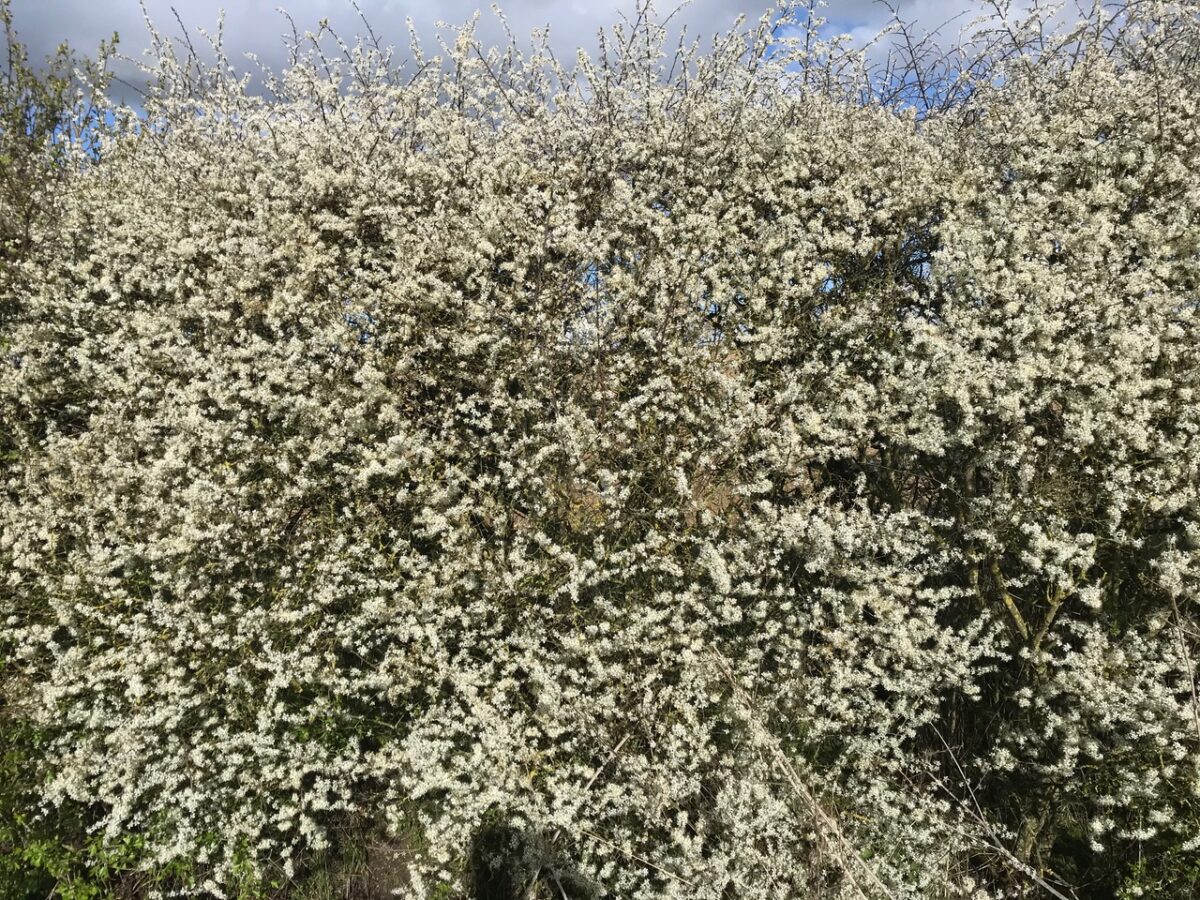
Climate change is changing our language too. Do you remember the old country saying about a ‘blackthorn winter’? It was a reference to that period in March and April when the blackthorn blooms in our hedges, well before the whitethorn (hawthorn) and other hedgerow species ever come into flower. This is a striking phenomenon in various ways. Most obviously, because in early spring the blackthorn blossom forms a brilliant white boundary along roadsides and across the fields, like a dazzling band of fresh snow. It’s one of the most cheering and beautiful early manifestations of what is for most people the most uplifting season of the whole year, with its promise of warmth, growth and light after the long winter’s wait while nature was battened down. One reason a blackthorn hedge looks so dramatic in spring is that unlike most other flowering bushes the blackthorn produces its flowers before its leaves, so the blossom contrasts strongly with its blackish bark, which looks as if it has been frosted like a Christmas decoration on every twig.
But the phrase ‘blackthorn winter’ referred also to the fact that this promise might be punctuated or delayed by sudden bitter spells and chilly blasts, as winter administered a final, sharp reminder of its powers. The nineteenth-century Scottish meteorologist, Alexander Buchan, even claimed to have identified a systematic pattern to these bitter spells, which became known as ‘Buchan’s cold snaps’. In fact, the occasional conjunction of the flowering blackthorn with short wintry interludes was an easy prediction to make, but Buchan made the mistake of being too precise about it. April 11-14 and 9-14 May were his spring dates for a seriously ‘cold snap’. Well, check it out when the time comes, but I’d be surprised if it happens. Buchan may have won credibility by sometimes being right, like a canny fairground fortune-teller who tells you that something interesting is about to happen to you, but it was actually pretty random. In any case, Buchan knew nothing then of climate change. We’ve scarcely had a winter in East Anglia this year, certainly not an old-fashioned freeze-up, just a handful of frosty nights and only one day I can remember with a single snow-flake (on my birthday, as it happened).
Perhaps the invocation of the ‘blackthorn winter’ will survive as a metaphor, annually celebrating the blackthorn’s dense drifts of white blossom, even as we re-define winter itself to suit the changing meteorological facts. But the phenomenon of snowy blossom appearing in warm March weather may presage the next impending crisis the world is facing – as well as creating a new proverbial reference to a ‘blackthorn spring’.
Jeremy Mynott
3 March 2026