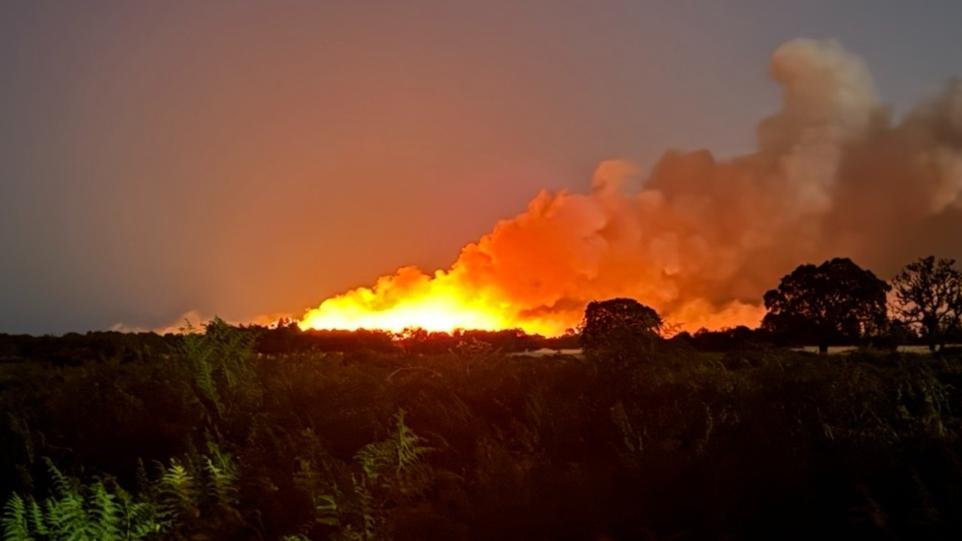
I write this as wildfires are burning just a few miles up the coast at Dunwich. It’s a disaster, at every level. A huge blaze has devastated a large area of our precious heathland, destroying swathes of beautiful heather and furze and with them all the wildlife they sheltered that couldn’t flee the advancing wall of flames: nestlings of birds like skylarks, meadow pipits, stonechats and such local heathland rarities as nightjars and Dartford warblers; small mammals like voles and hedgehogs; reptiles (lizards, slow-worms and adders); and countless butterflies, moths and other insects. All incinerated. There are heart-breaking reports, for example, of nightjars flying ahead of a twenty-foot fireball and leaving their fledglings to their horrific fate. Just imagine.
The Dunwich fire in August 2026.
The area affected spread over some 370 acres (150 hectares) of major National Trust and RSPB reserves, which had been carefully managed over very many years to protect the wildlife that is now being destroyed in a day. Newspaper reports describe the area burned as the equivalent of 210 football pitches, a rather bizarre metric; but bringing that comparison closer to home, it’s larger than the whole Sutton Hoo estate (255 acres), and nearly fifteen times as large as our own conservation area, the Shingle Marshes field (25 acres). The Dunwich fire represents a loss on a landscape-scale and they have started an appeal to support the recovery work, if you felt like contributing: https://www.nationaltrust.org.uk/support-us/appeals/dunwich-heath.
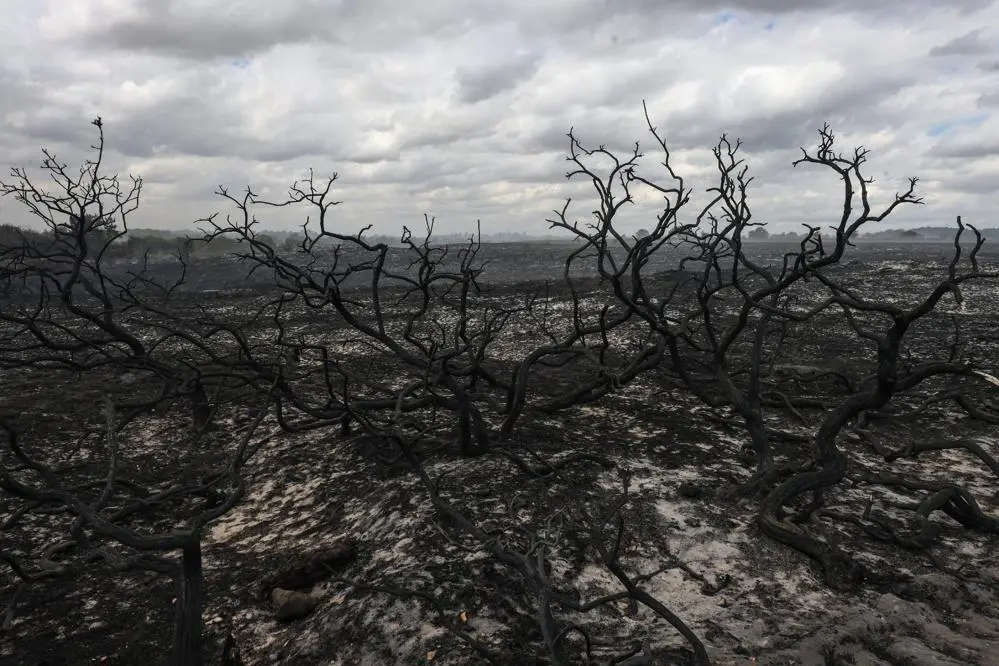
The scene looked apocalyptic from the photos – like a war zone. And that’s what it is, actually. This isn’t just a local problem – though it makes one very nervous about the whole coastal Suffolk strip, all tinder-dry now and very vulnerable. There have been wildfires raging this week across Europe in France, Spain and Greece, in Canada and in Washington state. It’s a world-wide threat. What’s more, we know where the threat is coming from. Climate change. All the talk is about adapting to the new normal of an over-heating world, and of course we do need to do that. But the deeper threat, and the cause of that danger, is in ourselves – our unwillingness or inability to cease adding fuel to the fires through our continuing carbon emissions.
The aftermath of the fire.
There’s a fable that long after life on this planet disappeared we were visited by observers from some distant, advanced civilisation elsewhere in the galaxy. What puzzled these extra-terrestrial historians was that what destroyed us was not some momentous event like an asteroid strike, viral pandemic or nuclear war; but that in our last days we carried on exactly as we had before and did nothing to avert the disaster we clearly saw coming our way.
Jeremy Mynott 2 August 2026
Nature note: Doodlebugs
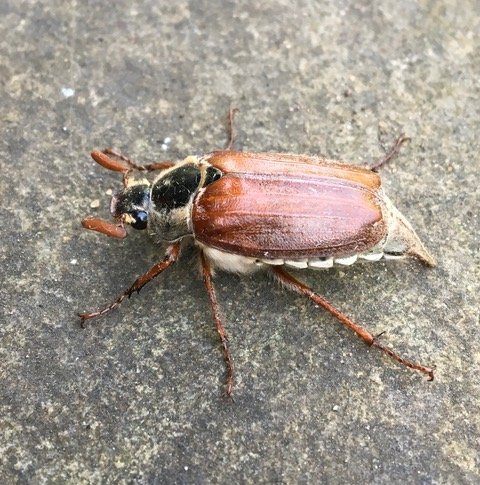
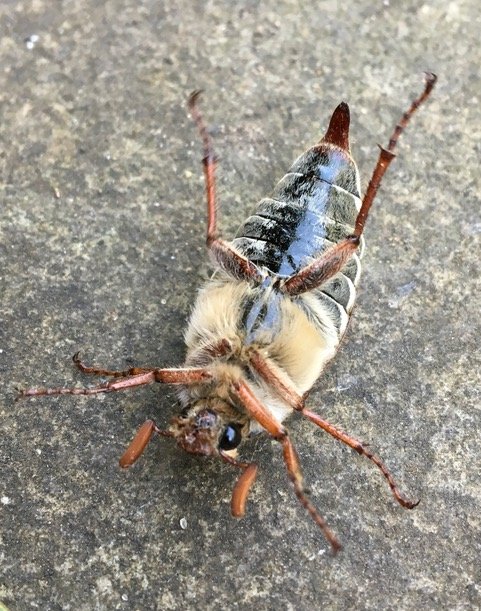
Which do you think are the most successful animals on the planet? Not mammals, with some 8,000 different species worldwide, nor even birds with over 10,000. It’s actually beetles, with well over 400,000 – and counting. The environmentalist J.B. Haldane famously quipped that ‘The Creator, if He exists, must have had an inordinate fondness for beetles.’ In Britain, the family includes such charismatic species as ladybirds, stag beetles and glow worms, but also some less popular ones. The Summer Bug, aka cockchafer or doodlebug, which is most active in May and June, can seem quite alarming when buzzing around noisily at night, especially if they bang into your windows with a sharp ping, attracted by the light. They are more clumsy than aggressive, in fact, and often end up on their backs waving their legs around rather pathetically or even knocking themselves out from the impact. They gave their name to something altogether more dangerous, however – the terrifying V1 flying bombs launched at Britain towards the end of World War II. Nicknamed doodlebugs these too would buzz loudly overhead but when their engines cut out above their targets there would be several seconds of heart-stopping silence before they exploded – and you breathed a guilty sigh of relief that it wasn’t your house.
The Summer Bug (aka Cockchafer or Doodlebug). Photo: Jeremy Mynott
One shouldn’t transfer that wartime doodlebug-dread back on to the beetles themselves, though. They are very handsome when you get a close look. They have grooved bronze wing-casings (the ‘elytra’), black heads, white fluffy down underneath and elaborate feathery antennae to enhance their sense of smell. There is also a related rose chafer you might see in your garden which glitters with a brilliant metallic green. Chafer is the old name for beetle and just means ‘one that chews’. They are vegetarians, feeding on leaves and roots. Cockchafers were once very abundant and became regarded as a serious agricultural pest because they gnawed the rootlets of young crops. There is even a place in Gloucestershire, Charingsworth, supposedly named after a swarm of chafers. Their numbers were later much reduced by pesticides, though there are still cyclical surges in the population.
A Cockchafer on its back. Photo: Jeremy Mynott
Chafer grubs constitute an important food-source for other creatures. When you see rooks or crows pecking deeply in a grass field they are probably after the fat, white cockchafer larvae (‘rookworms’). Badgers gorge on them too and will dig up your lawn if they think you’re harbouring any, while moles hunt them down from underground. In some cultures beetle-grubs also form a regular part of the human diet, while yet other kinds of beetles dispose of the world’s natural waste and debris. Everything in nature is connected, often surprisingly – including to us.
Jeremy Mynott June 2026
Nature Note: Murder on the Beach
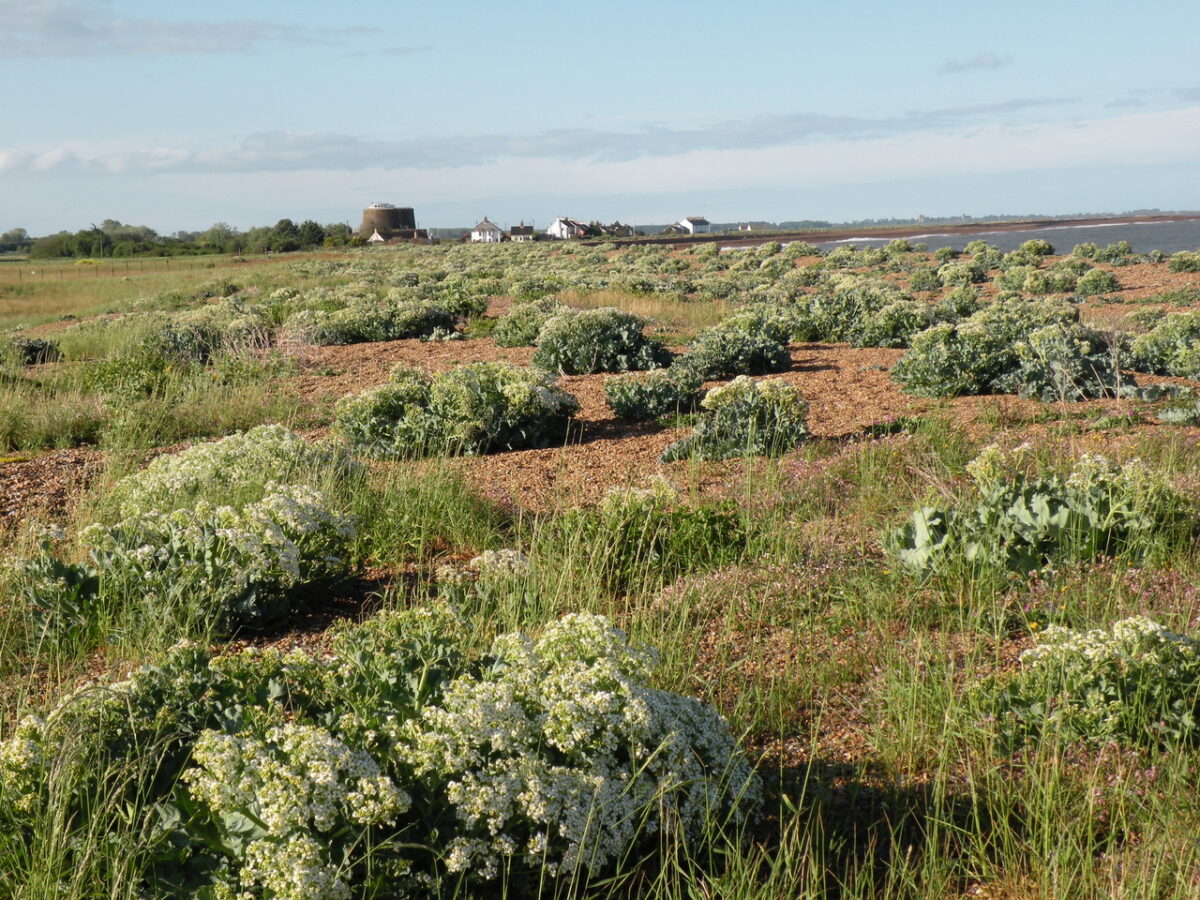
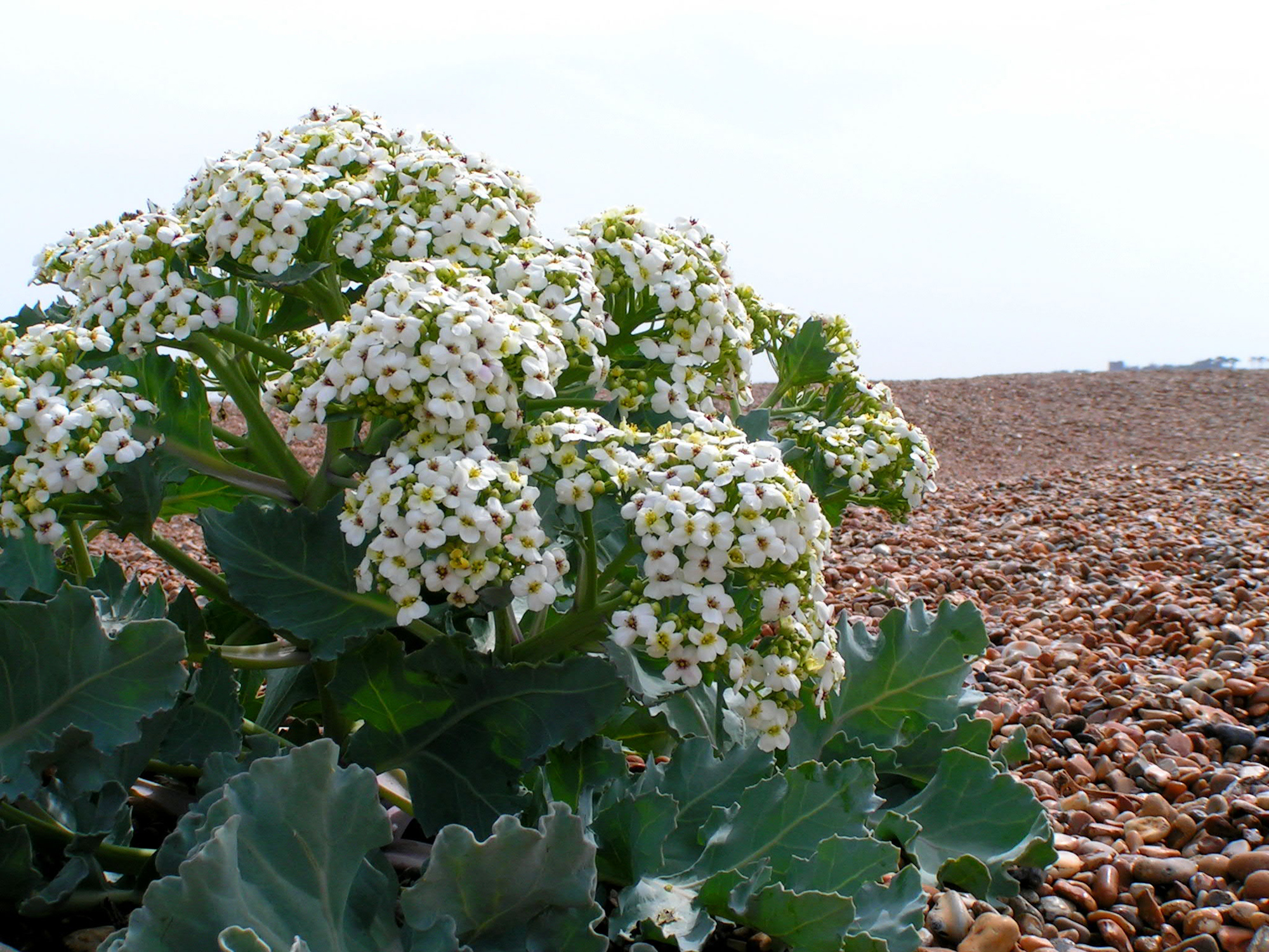
Shingle Street is famous for lurid stories about mysterious wartime fatalities on the beach, but we also had a better-documented one here last year. Our coastline is home to many rare and beautiful plants, none more striking than the Sea Kale that creates a wonderful swathe of foaming white blossoms on the shingle banks in early summer. Sea Kale is a kind of cabbage and when it emerges it looks for all the world as if the beach has suddenly sprouted gigantic cauliflowers everywhere. After Dungeness, this is one of the best places in Britain to witness this natural phenomenon. The Kale has to cope with an extreme environment, of course. It’s doused with salt spray, exposed to constant winds and parched by the sun; there’s no fresh water and almost no soil; while the shingle itself is unstable and constantly shifting. But the Sea Kale is specially adapted to cope with these testing conditions. It has very deep roots (up to two metres long) to suck up moisture and pale fleshy leaves to reduce water loss. The plant’s a survivor.
Sea Kale on the beach at Shingle Street. Photo: Jeremy Mynott.
Something very strange happened last year, however. Summer came and went but the kale didn’t bloom in the stretch of shingle in front of the houses, where it has been such an annual delight to residents and visitors alike. What happened? Theories abounded. Had the plants just got too old and were declining naturally? Was it some disease? A caterpillar plague? Were they being nibbled by hares (which do visit the shingle)? Or perhaps by the flocks of wood pigeons we have everywhere now? Or even by human foragers – after all, although it’s strictly illegal now, people used to pick Sea Kale as a culinary delicacy when the plant was common back in Victorian times and it was even recommended as a tasty alternative to asparagus in Mrs Beeton’s celebrated Cookbook of 1861. But none of these theories explained why the Sea Kale should be affected like this just at Shingle Street and not along the beach from a few hundred yards south and all the way to East Lane, Bawdsey, where it was still flourishing,
Sea Kale damage. Photo: Liz Moon.
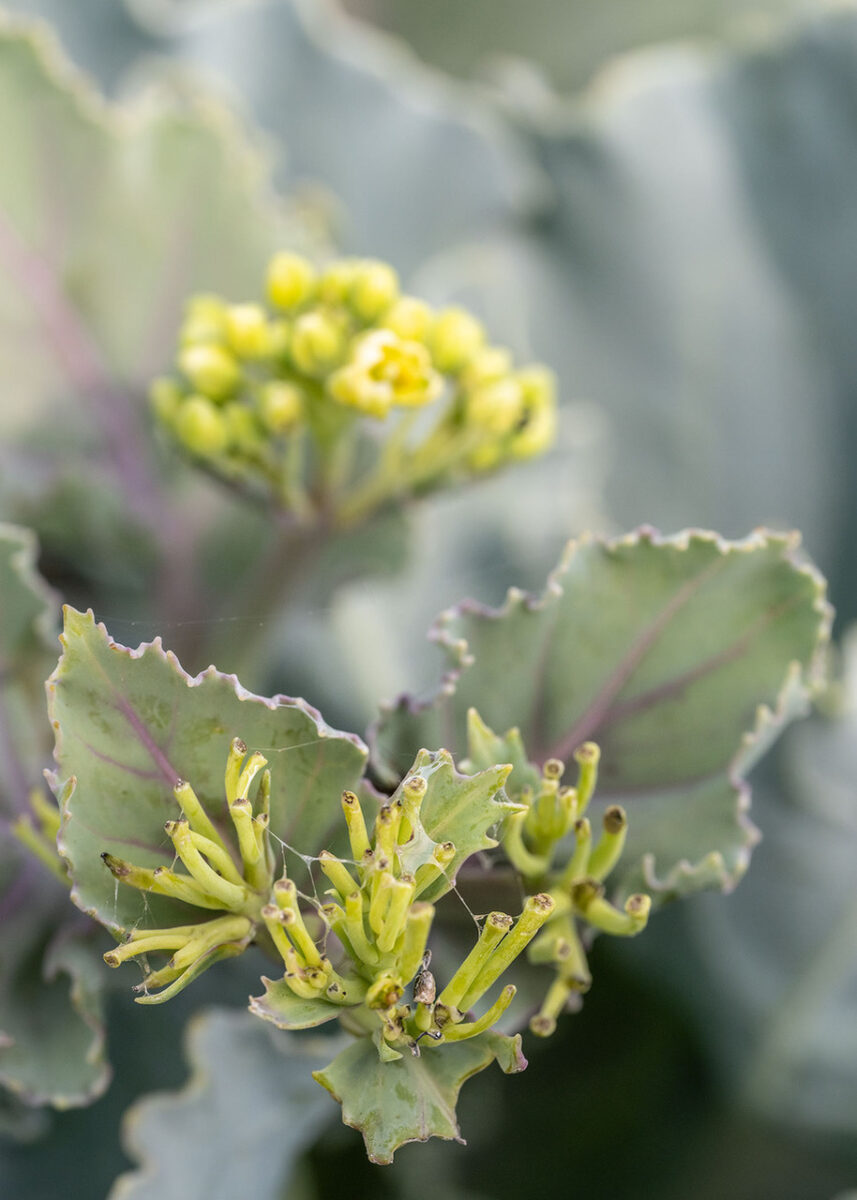
A vigilant insomniac here eventually came up with what seems to be the answer. She noticed that our resident muntjacs had started boldly browsing on the beach at night, maybe because the inland plants had been desiccated by last years’s long spring drought; and her observation was later confirmed by some close-up photos that showed the Sea Kale stalks nipped off cleanly at the top. What will happen this year? And what’s the solution? Is it a choice between cabbage and venison?
Jeremy Mynott April 2026
Nature Note: Buckthorn Beauties
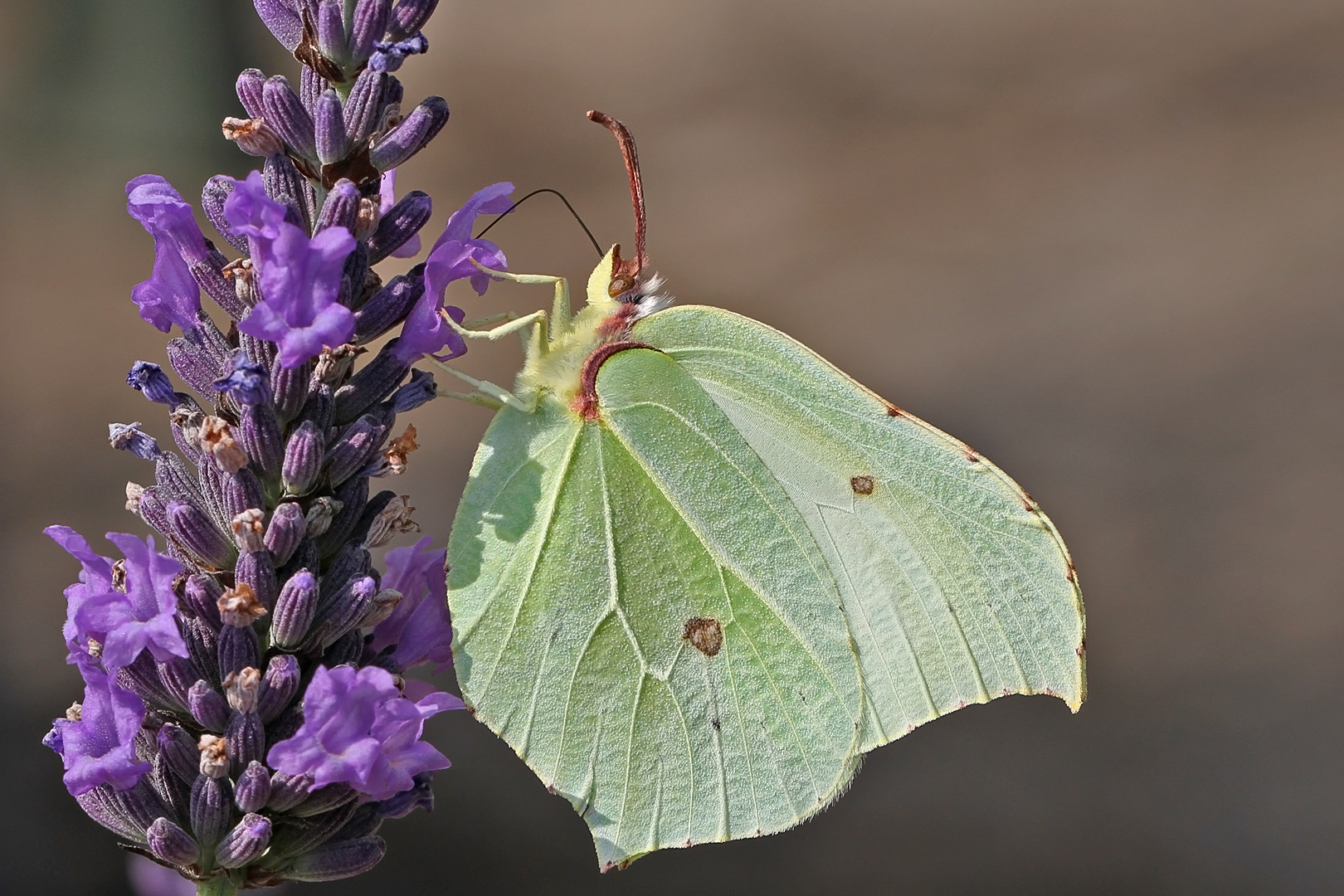
Not long to go now. March is the beginning of spring in our meteorological calendar. It was the first month of the year for the ancient Romans, who called it ‘Martius’ after Mars, their God of War, because it was the season when the weather became good enough for them to start fighting again. We have inherited the name and for us too it marks a beginning, but happily of a more creative kind. It’s the start of that unstoppable rush of new life, light and growth as the green wave of spring moves northwards through Europe and reaches our shores. We all have our own markers of this annual rebirth: the daffodils flowering, the hedges leafing, a chiffchaff singing in the copse on its return from Africa, or a wheatear in fresh plumage foraging on the beach. But for me one of the most stirring is that first sight of a butterfly on the wing, probably a lovely brimstone floating round a sheltered garden on a sunny day in early March.
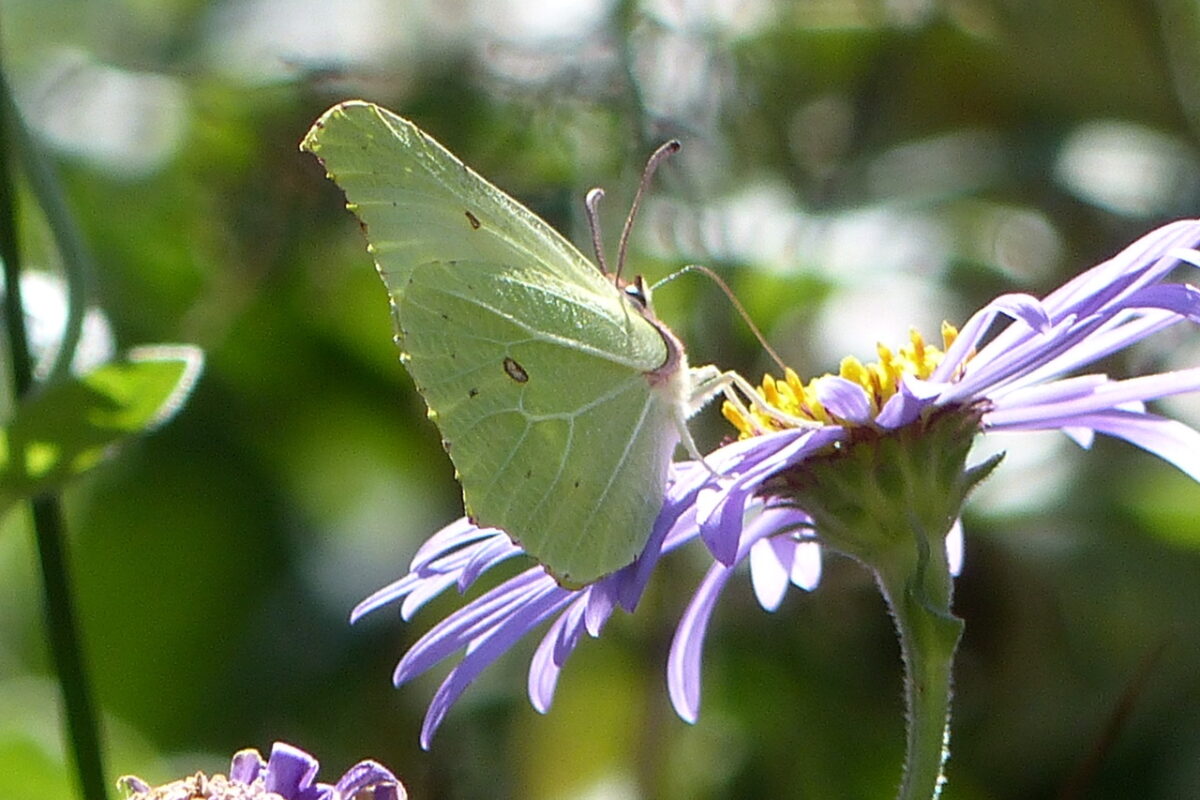
A Brimstone butterfly. Photo: Jenny Desouter.
They are so-named after the colour of brimstone, the old name for sulphur (remember ‘fire and brimstone’ in the Bible?). The male brimstone is a gorgeous buttery yellow, the female paler (and slightly larger), but both unmistakeable on the wing with large rounded wings hooked at the tip and a strong buoyant flight. When they settle they always do so with wings closed and their wonderful camouflage is then displayed, their greenish veined underwings looking for all the world like leaves. It has been suggested that the male’s striking colouration is the origin of the name butterfly itself, a ‘butter-coloured fly’ – an attractive thought, but unlikely alas. Brimstones appear this early in the year, not because they have just emerged from a chrysalis but because they are one of the few British butterflies that actually overwinter as adults. At the first hint of any warmth in the sun they come out from their winter hiding-places, where they have been concealed in thick ivy or other evergreens like holly, and search out some reviving nectar. They’ll often suck it from early flowering daffodils and primroses, but their most favoured sources are purplish flowers like knapweed, teasel or thistle, and in the latter two a brimstone can reach down into the plant with its long proboscis further than most other butterflies.
The favourite food plant of their caterpillars, however, is buckthorn (common or alder), which is not very widely distributed so they need some nearby to lay their eggs on. Brimstones are also one of our most long-lived butterflies, emerging one summer and lasting right through to the next. Worth planting some buckthorn for?
Jeremy Mynott February 2026
Nature Note: Charismatic Guests
This is the time of year, as the days darken into winter, when some charismatic visitors arrive to dispel something of the dank and gloom. They come from the forests and fields of Scandinavia, arriving usually by night – long-winged, silent travellers seeking a milder climate and more readily available food supplies. Short-eared owls. Every year they grace our marshes and grasslands, patrolling them for the small rodents which are their staple fare, especially field voles. Unlike most owls these short-ears hunt by day. They rely on a combination of sight and hearing, both exceptionally acute by human standards, to locate their tiny prey from above and seize it in a sudden plunging descent. It makes for a wonderful spectacle for bystanders. The owls quarter the field, flying low over the ground, now gliding, now slip-sliding or hovering for a better look; then the final, and for their victims terminal, deep dive. You can often watch them close-up from the roadside and marvel at their variegated plumage of soft browns, buff, tawny and in some lights ochre-tinted colours, contrasting with dramatic orange eyes set in black mascara-lined sockets. Their numbers vary by the year, depending on the fluctuating cycle of rodent populations. It is said that they can consume some 2,000 voles in their four-month winter sojourn among us – did you realise we had so many? Some short-ears linger into the spring and occasionally even stay to breed on local marshes and seawalls. Further north in Britain they breed regularly on the moors and uplands but here they are thrilling seasonal visitors.
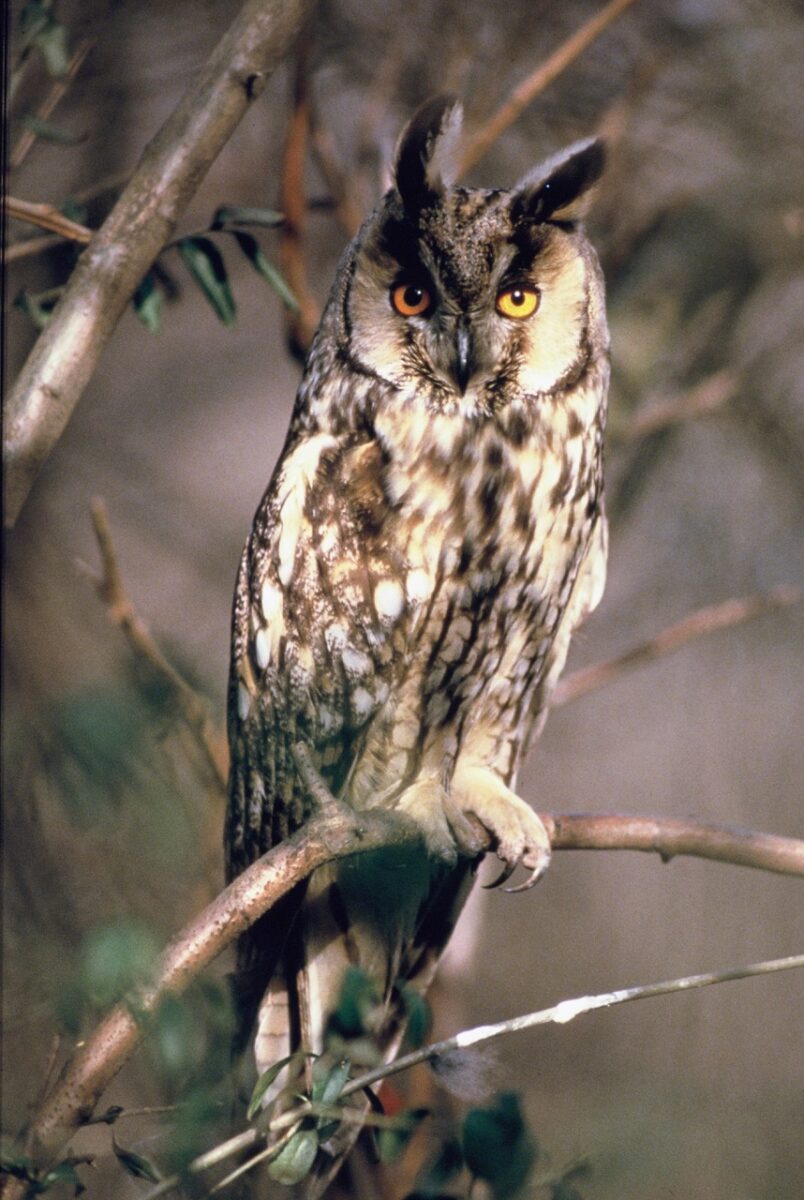
Long-eared owl
Their name sounds faintly ridiculous and indeed the small protrusions on their heads are not ears at all but just little feather tufts. Their real ears are lower down on the head, invisible through the thick plumage and positioned asymmetrically, one higher than the other, to give them a better positional fix on the faintest rustlings below. There is also a better-endowed owl called the long-eared owl (LEO, to birdwatchers), with very prominent long ear-tufts. These are resident in Britain and quite widely distributed but are purely nocturnal, very secretive and rarely seen. Their numbers are supplemented by migrants from Scandinavia in winter, too, and LEOs are occasionally spotted in their temporary winter roosts. A neighbour of mine had a magical epiphany the other day when she drew back the bedroom curtains in the morning and saw one sitting on a horizonal branch just a few feet away outside, staring directly in at her. Wisely, she didn’t broadcast this great discovery so the legion of owl-obsessed bird-photographers never troubled it and it left the next night like a fading dream.
Jeremy Mynott November 2025
Nature Note: Here be Dragons
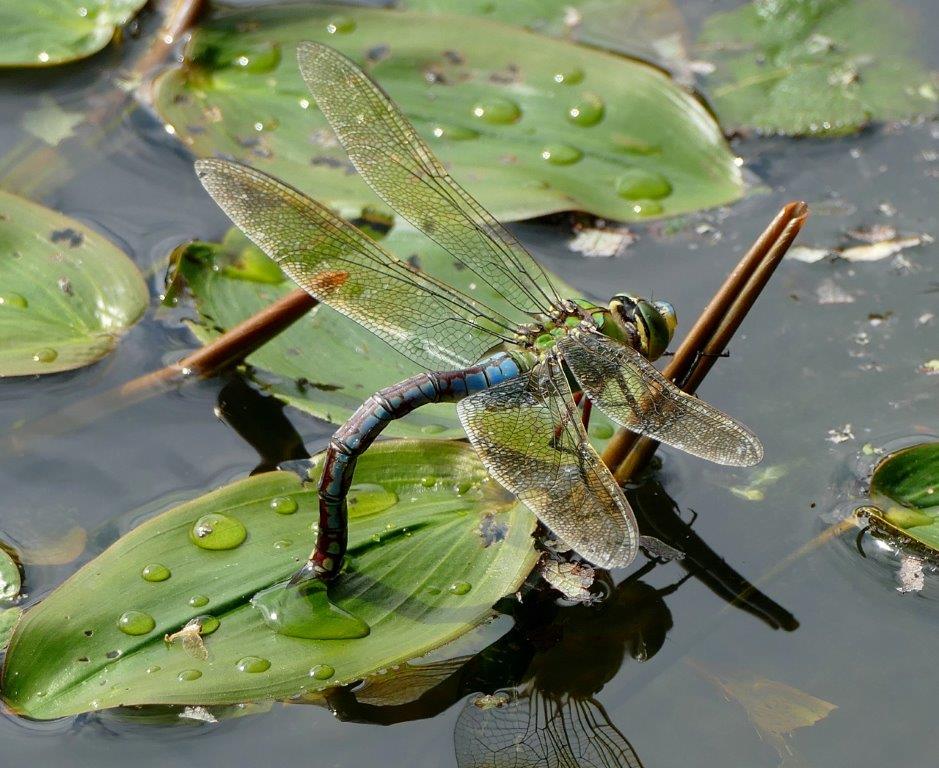
One thing we lack in Shingle Street is fresh water, so our small garden ponds can be a real magnet for wildlife. One recent visitor at ours has been a magnificent Emperor Dragonfly, fiercely patrolling this tiny kingdom, as the scientific name Anax Imperator ‘Lord and Ruler’ suggests. As lord of all he surveys, the dragonfly sees a great deal. They have huge compound eyes made up of some 30,000 separate facets or lenses, so they can see objects in all directions simultaneously and with very great precision. They really do have eyes in the back of their heads. The ‘dragon’ in their name, which probably comes from a Greek word denoting sight, suits the dragonfly well since they are ferocious hunters of other insects, including butterflies, which they can seize in the air, manoeuvring at high speed in any of six directions – up and down, left and right, forwards and even backwards. The aerodynamics of dragonfly wings inspired the design of the flight-blades for the first Royal Navy helicopters named ‘The Dragonfly’ and more recently influenced modern drone technology, still catching up with nature’s own exquisite artifice.
We get little blue damselflies over the pond, too. You can tell a damselfly not just from the size and shape – dragonflies being large and bulky, damselflies petite and thin – but from the way damselflies hold their wings tightly folded when resting, rather than open like an aeroplane as dragonflies do. Damselflies also have their eyes touching close together not separated. It’s a gentler, more feminine name, suited to their dainty proportions, but they too are carnivorous, feeding on smaller flying insects. At the other end of the scale there was once a massive prehistoric dragonfly, the Meganeuropsis, about the size of a crow, but we’ve fortunately missed that by about 250 million years.
Female Emperor Dragonfly. Photo: John Rainer.
If you look closely you’ll see that a dragonfly is composed of three parts: a head with those all-seeing bulging eyes, a thorax (body) and an abdomen (tail). The thorax is the engine-room, where the muscles that power these aerial feats are located, while the tail can have a further function. Our visitor was a female and was pausing frequently to insert her long ovipositor (egg-laying tail) into the weeds to eject a stream of eggs that in about three weeks should develop into dragonfly larvae, which will in turn live in the pond for months, gorging on tiny aquatic life and emerging eventually one night as adult dragonflies. Their reign in the skies will only last a couple of months, alas, but these gauzy beauties are emblematic of a sleepy English summer and fleeting dreams of impossible creatures.
Jeremy Mynott August 2025
Nature Note: What’s Missing?
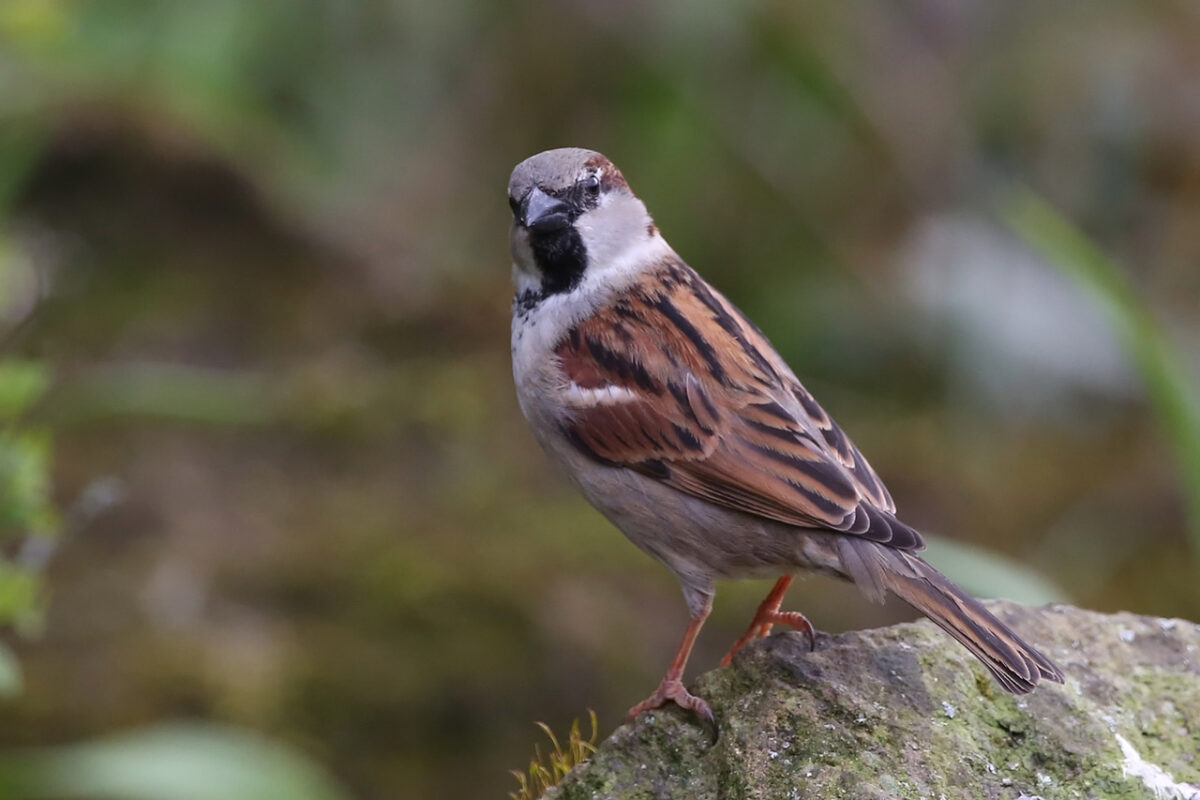
It’s easier to notice changes when they involve presences rather than absences. We may be very aware of a new person in our community but we can forget that we haven’t seen old so-and-so around for quite some time, now that you mention it. It’s the same with our wildlife. It makes the headline news when charismatic species like red kites, ospreys and white storks are re-introduced into Britain, but how many people realise that in the meantime we’ve lost 70% of our humble house sparrows?
Sparrows used to be one of our commonest birds. From earliest historical times they thrived around human habitations in cities and farms, to the point of becoming pests. We exported them to the USA in the mid-nineteenth century (a few were released in Brooklyn in 1853) and in no time at all they had spread from coast to coast; indeed, by the 1940s there were more sparrows than people in America. And only 30 years ago in Britain they were still as common as, well, sparrows. The ‘Cockney sparrow’ was the affectionate nickname for this small, cheeky little bird living alongside us, with its touch of endearing vulgarity. But there’s been a crash in the population and you can search for them in vain in London now. A friend of mine used to birdwatch in Hyde Park every day and in ten years he never saw a single sparrow. What’s happened?
House sparrow
Scientists have come up with explanations ranging from habitat loss, climate change, improvements in domestic architecture (so fewer nesting holes), growing predator numbers (like magpies and cats), pesticides and air pollution (especially from diesel vehicles); but none of these seems fully convincing or specific to sparrows – why, for example, are there still plenty of sparrows in other big cities like New York and Paris? One more inventive speculation is that house sparrows are essentially social creatures and if the colony size drops below a certain level they can’t any longer function as individuals, especially as they are also extremely sedentary and localised. Sparrows don’t migrate, even short distances, to occupy empty niches elsewhere, so they find it hard to recover from a decline brought on by other factors. Could it be like the human situation in the remote Hebridean island of St Kilda in 1936, when the population had declined to 36 people and they could no longer be self-sufficient so had to be physically evacuated and resettled?
Here in Shingle Street we still have a small colony of house sparrows, I’m glad to say, but they’re getting rarer. Should we be resettling sparrows here as well as kites and storks? Could be an interesting negotiation with an export-minded US president.
Jeremy Mynott July 2025
Nature Note: Look up, Quick
I was taking a stroll on one of those lovely long midsummer evenings, watching the swallows swooping low over the fields for their final feed of the day. They were calling occasionally, a gentle veetveet, which is their standard conversational contact call. But suddenly one gave a much louder, piercing cry and they all instantly scattered as if in a shock-wave and dived for safety. I looked up and knew what I’d see – the sinister dark silhouette of a falcon shearing through the sky. This was the swallow’s special ‘hobby alert’ call.
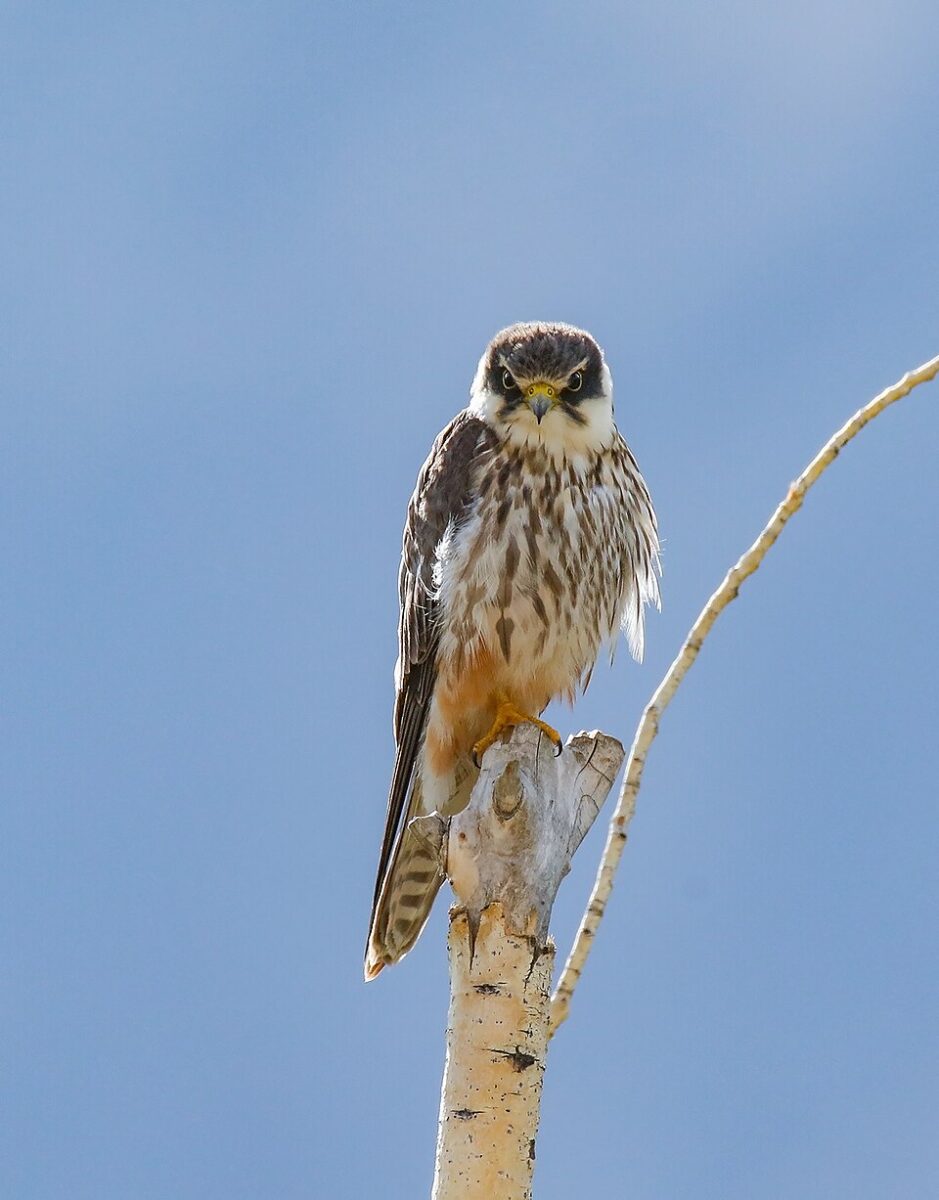
Most of our common birds of prey – kestrel, sparrow hawk, buzzard, peregrine and red kite – are resident in Britain throughout the year, but we have one that is just a summer visitor, the hobby. Why only in summer? Well, that’s when its favourite prey is available, the swallows, martins and swifts, which it follows here each spring. And it’s the only raptor with the specialist aerial skills to catch them. Swifts and swallows are wonderful fliers themselves, of course, but they are no match for a hunting hobby, which is capable of breath-taking twists and turns at high speed to chase them down on the wing. It’s such a deadly threat that the swallows have evolved this special call as an air-raid warning. Hobbies also take dragonflies in large numbers, which they do with almost nonchalant ease, plucking them from the sky as they cruise along and then nearly stalling in mid-air to strip out the soft bodies and consume them in flight.
Hobby (photo: public domain)
Seen close-up, hobbies are very handsome birds with slate-coloured backs, white cheeks, black moustaches and rufous feathered ‘trousers’. But they are quite easy to distinguish in flight, too. Unlike a kestrel they never really hover, but scythe around, alternately soaring and diving on sharply angled wings, rather like huge swifts. They are much smaller than, say, buzzards. Indeed, their Latin name is Falco subbuteo and since a buzzard is a buteo this literally means ‘a falcon one size down from a buzzard’. And herein lies an etymological curiosity. Do you remember the table-football game called Subbuteo, which was very popular in the last century? The inventor of that game, one Peter Adolph, wanted to call it ‘Hobby’, partly because it was a hobby in the other sense of ‘pastime’ and partly because the hobby was his favourite bird. But when in 1948 he tried to register it as a trade-mark under that name, the Patents Office refused him for some reason, so he called it by its Latin name instead and they approved that. A little natural history sometimes helps.
Jeremy Mynott 9 June 2025
Nature Note: Yellow Bird of Summer
Sometimes just a momentary experience can release a whole theatre of memories. Walking a nearby country lane, I glimpsed a flash of yellow atop the hawthorn hedgerow and heard a hoarse jingle that conjured up the seemingly endless summers of childhood. A yellowhammer. The first half of the name is clear enough; while the second half probably comes from the Old English amer, meaning a bunting, so they are really ‘yellow buntings’. The males have brilliant canary-yellow heads in spring, with a paler suffusion on the underparts – to my eye, a much happier blend with the palette of colours in the English countryside than the harsh yellow glare of the rape fields I see beyond. The hoarse song is traditionally rendered as ‘a little-bit-of-bread-and-no-cheese’, though it actually sounds more like the less grammatical ‘little-bit-of-bread, cheeeeze’ (a stutter followed by a wheeze). The song isn’t exactly euphonious –Coleridge likened it to someone filing brass – but they will now go on singing this refrain tirelessly until autumn and its repetition would be grating if it wasn’t so evocative of hot summers, dusty roads and healthy hedgerows.
A Yellowhammer. Photo: Jenny Desoutter.
One of the yellowhammer’s old country names was ‘scribble lark’, because their eggs are delicately inscribed with a loose series of wavy lines resembling even worse handwriting than mine. Other regional names invoke different associations. The Welsh name (is melyn yr eithin, meaning ‘yellow bird of the gorse’; while I hesitate to explicate the Scots name yorlin, which Robbie Burns exploited in a double-entendre so coarse that the BBC’s spoken rendering of his poem, ‘The Yellow, Yellow Yorlin’, comes with a trigger-warning …
To recite these scraps of folklore may be thought to view the yellowhammer through a golden haze of nostalgia, however. The countryside is changing. The rape fields whose colour seems garish and alien to me have been with us since the 1980s, so are already a part of a new tradition for others. And one remembers how the nineteenth-century peasant-poet John Clare bitterly lamented the enforced replacement of his familiar open-field landscapes with the very enclosing hedgerows that we in turn seek to preserve and restore. Nonetheless, if the yellowhammer eventually joins the other local casualties of intensive agriculture like the corn bunting, the turtle dove and the tree sparrow, I can’t just view that as an inevitable secular process. I feel these losses as an impoverishment, not just another change. And it’s no consolation to have this diminution of our natural heritage diagnosed in technical Eco-speak as the ‘Shifting Baseline Syndrome’, whereby each generation adjusts to a new and diminished ‘normal’. What we need is an Ascending Recovery Scale.
Jeremy Mynott 4 May 2025
Migrants
21 Apr 2025
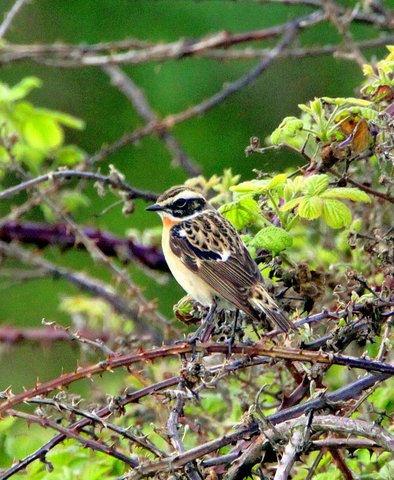
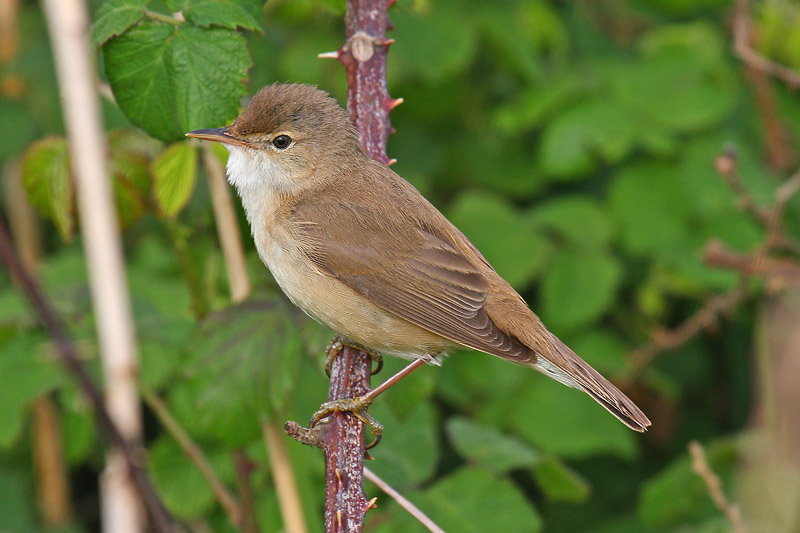
Seven different warbler species singing in the bushes and reedbeds, plus a fine male whinchat perched on the fence at Lavender Cottage!