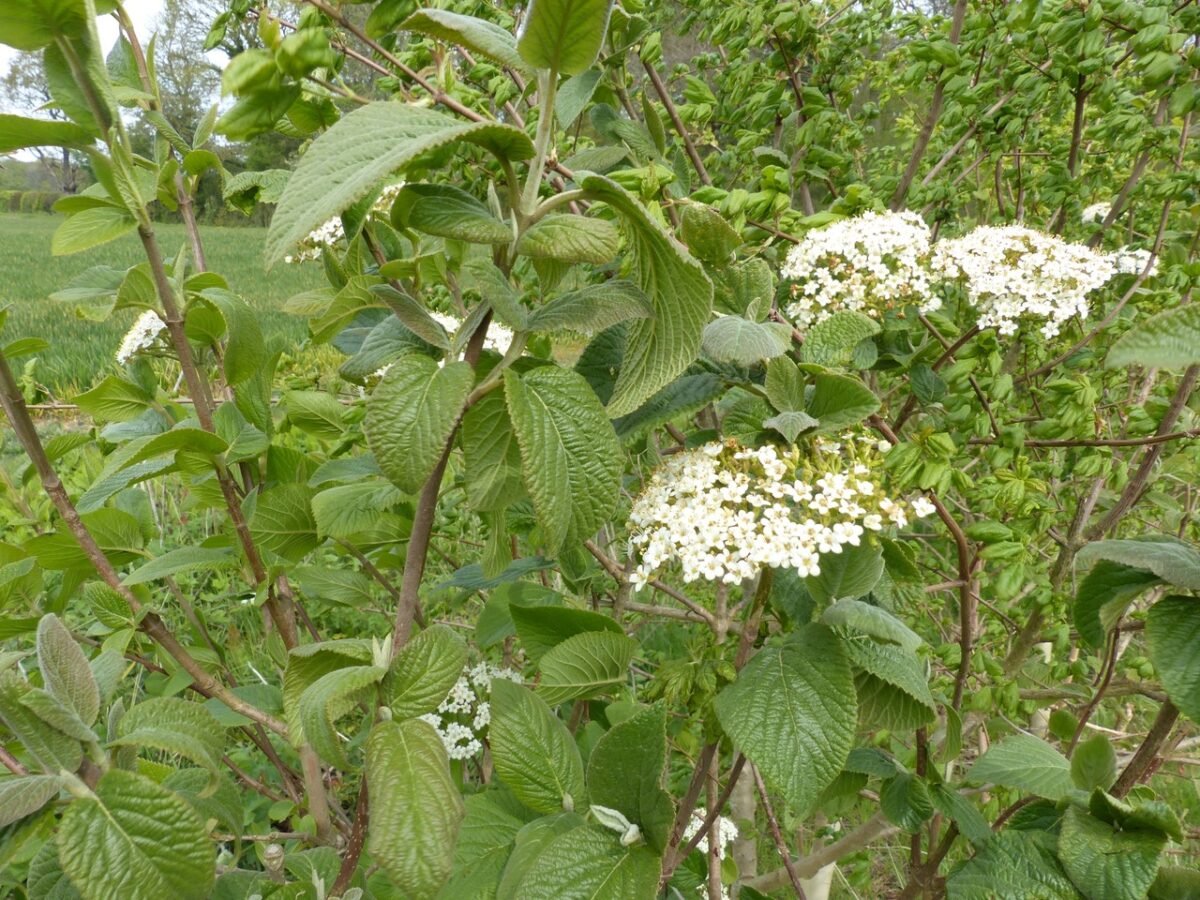
Our hedgerows rank high among the great glories of spring. You can follow them greening up day by day, from the first fresh buds in March through to the gorgeous extravagance of leaves and blossom in May. It’s an annual miracle of renewal and rebirth, driven by what the peasant-poet John Clare happily called, ‘the green life of change’. You can follow the succession of different hedgerow trees and bushes emerging in flower one by one – and revealing in the process just how many different species were hiding there unnoticed in the bare, skeletal hedgerows of winter. I just came across an old favourite while rambling along an ancient footpath, my attention caught by a lovely display of, creamy-white flowerheads shouldering vigorously through a mixed blackthorn and hawthorn hedge. A wayfaring tree. Their flowerheads look superficially similar to elderflower, but those come later and have quite different leaves (and, in autumn, berries). The wayfarer’s leaves are as attractive as the flowers – soft and wrinkly with fine veins, slightly coarse to the touch and downy-white on the undersides, hence its old country name ‘hoarwithy’. The present common name is a corruption of ‘wayfarer’s tree’, so called because it flourished alongside established footpaths and so helped reassure walkers that they were on the right track. It was the sixteenth-century botanist, John Gerard, who gave it this name, and since he also named ‘traveller’s joy’ (old man’s beard) perhaps he had a special sympathy with ramblers.
It’s a revelation in fact how many other hedgerow species are there once you really start looking. In the same stretch I found field maple, dog rose, crab apple, dogwood, hazel and spindle, along with the dominant hawthorn and blackthorn, suggesting that this must be a very ancient hedgerow indeed. There’s a calculation called Hooper’s Law which is supposed to enable you to age a hedge by multiplying the number of species in a thirty-yard stretch by 110. But that would push the date of my hedge back to Domesday, which seems unlikely. I’m happy just to celebrate it, anyway. We’re lucky to have any ancient hedges at all. The British countryside went through a devastating period in the 1960s and 1970s, when farmers were encouraged to grub out hedges and drain ditches to enlarge fields to accommodate bigger and more ‘efficient’ agricultural machinery. We lost thousands of miles of hedgerows, and with them a huge slice of our wildlife, for which hedges act as shelters, corridors, larders and homes – mammals, birds, flowers and insects, the whole inter-connected chain of life. Many hedgerows have since been replanted, but you can’t make an old hedge any more than you can an old friend.
Jeremy Mynott
May 2026