Nature Notes is a series of articles written by Jeremy Mynott and published monthly in Village Voices, the local magazine for Shingle Street and nearby villages.
Nature Note: Wildfire
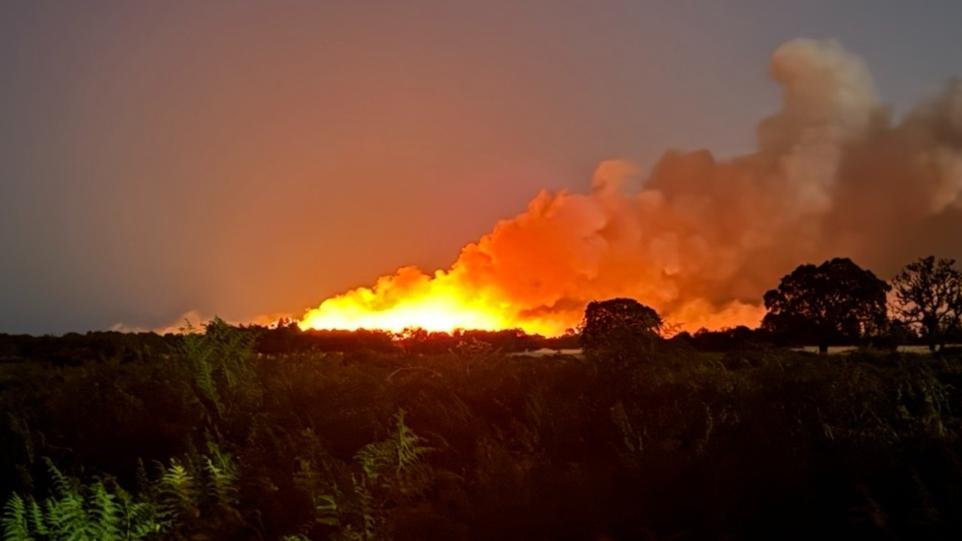
I write this as wildfires are burning just a few miles up the coast at Dunwich. It’s a disaster, at every level. A huge blaze has devastated a large area of our precious heathland, destroying swathes of beautiful heather and furze and with them all the wildlife they sheltered that couldn’t flee the advancing wall of flames: nestlings of birds like skylarks, meadow pipits, stonechats and such local heathland rarities as nightjars and Dartford warblers; small mammals like voles and hedgehogs; reptiles (lizards, slow-worms and adders); and countless butterflies, moths and other insects. All incinerated. There are heart-breaking reports, for example, of nightjars flying ahead of a twenty-foot fireball and leaving their fledglings to their horrific fate. Just imagine.
The Dunwich fire in August 2026.
The area affected spread over some 370 acres (150 hectares) of major National Trust and RSPB reserves, which had been carefully managed over very many years to protect the wildlife that is now being destroyed in a day. Newspaper reports describe the area burned as the equivalent of 210 football pitches, a rather bizarre metric; but bringing that comparison closer to home, it’s larger than the whole Sutton Hoo estate (255 acres), and nearly fifteen times as large as our own conservation area, the Shingle Marshes field (25 acres). The Dunwich fire represents a loss on a landscape-scale and they have started an appeal to support the recovery work, if you felt like contributing: https://www.nationaltrust.org.uk/support-us/appeals/dunwich-heath.
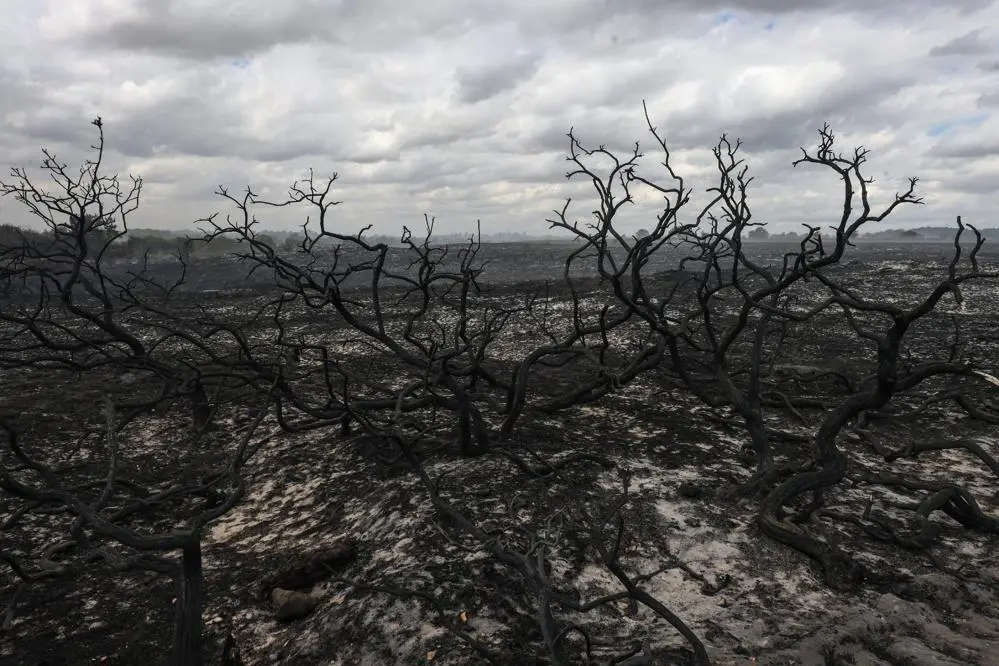
The scene looked apocalyptic from the photos – like a war zone. And that’s what it is, actually. This isn’t just a local problem – though it makes one very nervous about the whole coastal Suffolk strip, all tinder-dry now and very vulnerable. There have been wildfires raging this week across Europe in France, Spain and Greece, in Canada and in Washington state. It’s a world-wide threat. What’s more, we know where the threat is coming from. Climate change. All the talk is about adapting to the new normal of an over-heating world, and of course we do need to do that. But the deeper threat, and the cause of that danger, is in ourselves – our unwillingness or inability to cease adding fuel to the fires through our continuing carbon emissions.
The aftermath of the fire.
There’s a fable that long after life on this planet disappeared we were visited by observers from some distant, advanced civilisation elsewhere in the galaxy. What puzzled these extra-terrestrial historians was that what destroyed us was not some momentous event like an asteroid strike, viral pandemic or nuclear war; but that in our last days we carried on exactly as we had before and did nothing to avert the disaster we clearly saw coming our way.
Jeremy Mynott 2 August 2026
Nature note: Beware Hemlock
If you walk the sea-walls regularly you’ll be familiar with the cow parsley and hogweed that flourish either side of the path in an attractive white avenue. They are among the commoner members of the large family of flowering plants called Umbellifers, that is, plants with umbels, those clusters of whitish flowers supported by little stalks spread out like umbrella ribs. Other members of the family include economically important plants like chervil, wild carrot, fennel, parsnip, angelica, parsley and dill, so you may find some of them in your favourite salads and summer dishes.
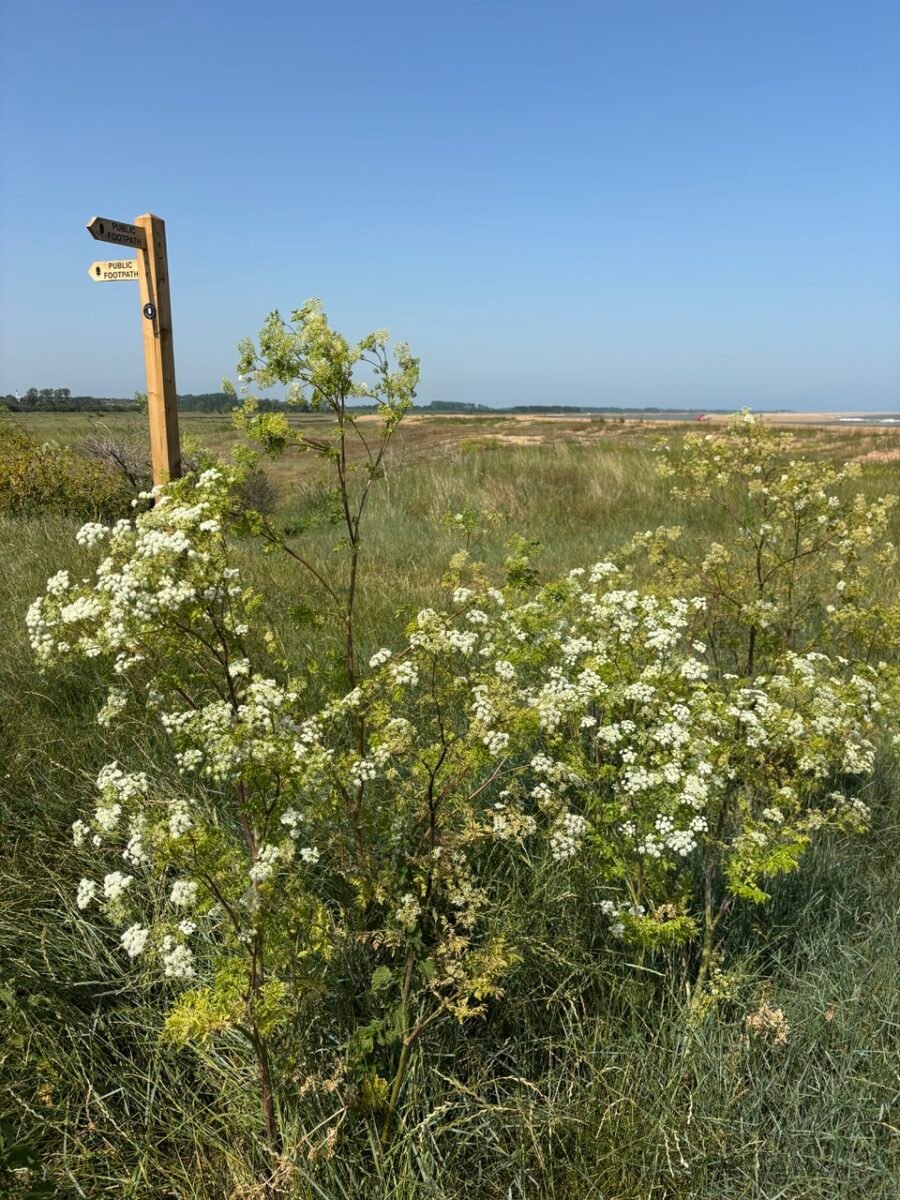
Beware imposters, though, especially if you are a wild flower forager. There is a deadly look-alike among them – hemlock. Hemlock leaves are bright green, rather fernlike, and with jagged edges; but the easiest way to distinguish them is by the stems, which are spotted with purplish dots and blotches. Every part of this plant is potentially dangerous – leaves, seeds, stems and roots – and dangerous to livestock and dogs as well as to humans if ingested. Animals know well enough to avoid it, however, deterred by its pungent mousy smell.
Hemlock at Shingle Street. Photo: Jeremy Mynott.
Hemlock is a native and widespread plant in Europe and its properties have been well-known for at least 2000 years. It was the poison of choice for public executions in ancient Greece and its most famous victim was the philosopher Socrates, who was condemned to death by the state for teaching the young to ask difficult questions of their politicians. His pupil Plato gives us a very moving eye-witness account of Socrates’ final hours as he is administered his dose of hemlock, combined with opium to dull the pain. The philosopher goes on discoursing cheerfully with his friends as the poison works its way up his body until he finally loses consciousness. Later herbalists experimented with ways of using very small doses of hemlock to treat complaints like gout, but don’t try this at home!
You can read an account of the terrible bodily torments Socrates might actually have suffered in a splendid new book by the botanist Peter Marren, The Devil’s Garden, in which he enthusiastically describes all the world’s most deadly plants with his deadpan graveyard humour. Maybe don’t show it to your gardener, though.
Hemlock is commoner here than you might think. There is a patch on the sea wall by the northern carpark at Shingle Street. And it is rampant along the verges of the A12 and other main roads, fuelled by nitrogen-laden car fumes. The Victorians used flowers as symbols to send covert messages, usually romantic ones, but if you were sent a sprig of hemlock the message was ‘You’ll be the death of me’.
Jeremy Mynott July 2026
Nature note: Doodlebugs
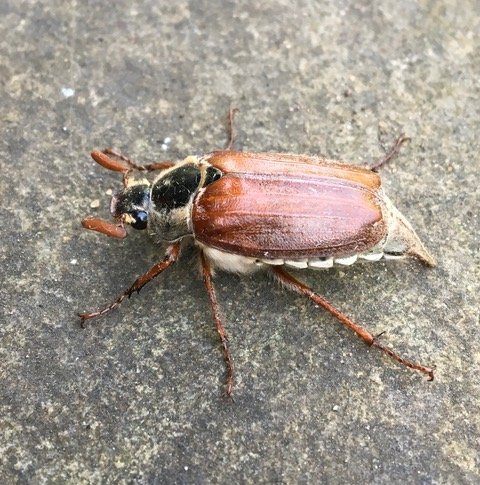
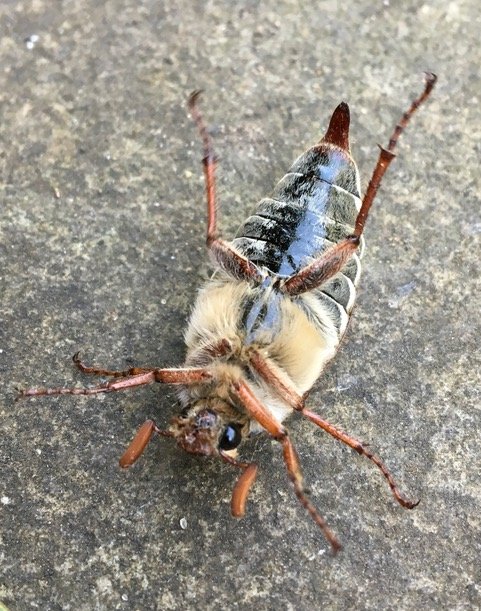
Which do you think are the most successful animals on the planet? Not mammals, with some 8,000 different species worldwide, nor even birds with over 10,000. It’s actually beetles, with well over 400,000 – and counting. The environmentalist J.B. Haldane famously quipped that ‘The Creator, if He exists, must have had an inordinate fondness for beetles.’ In Britain, the family includes such charismatic species as ladybirds, stag beetles and glow worms, but also some less popular ones. The Summer Bug, aka cockchafer or doodlebug, which is most active in May and June, can seem quite alarming when buzzing around noisily at night, especially if they bang into your windows with a sharp ping, attracted by the light. They are more clumsy than aggressive, in fact, and often end up on their backs waving their legs around rather pathetically or even knocking themselves out from the impact. They gave their name to something altogether more dangerous, however – the terrifying V1 flying bombs launched at Britain towards the end of World War II. Nicknamed doodlebugs these too would buzz loudly overhead but when their engines cut out above their targets there would be several seconds of heart-stopping silence before they exploded – and you breathed a guilty sigh of relief that it wasn’t your house.
The Summer Bug (aka Cockchafer or Doodlebug). Photo: Jeremy Mynott
One shouldn’t transfer that wartime doodlebug-dread back on to the beetles themselves, though. They are very handsome when you get a close look. They have grooved bronze wing-casings (the ‘elytra’), black heads, white fluffy down underneath and elaborate feathery antennae to enhance their sense of smell. There is also a related rose chafer you might see in your garden which glitters with a brilliant metallic green. Chafer is the old name for beetle and just means ‘one that chews’. They are vegetarians, feeding on leaves and roots. Cockchafers were once very abundant and became regarded as a serious agricultural pest because they gnawed the rootlets of young crops. There is even a place in Gloucestershire, Charingsworth, supposedly named after a swarm of chafers. Their numbers were later much reduced by pesticides, though there are still cyclical surges in the population.
A Cockchafer on its back. Photo: Jeremy Mynott
Chafer grubs constitute an important food-source for other creatures. When you see rooks or crows pecking deeply in a grass field they are probably after the fat, white cockchafer larvae (‘rookworms’). Badgers gorge on them too and will dig up your lawn if they think you’re harbouring any, while moles hunt them down from underground. In some cultures beetle-grubs also form a regular part of the human diet, while yet other kinds of beetles dispose of the world’s natural waste and debris. Everything in nature is connected, often surprisingly – including to us.
Jeremy Mynott June 2026
Nature Note: Wayfaring
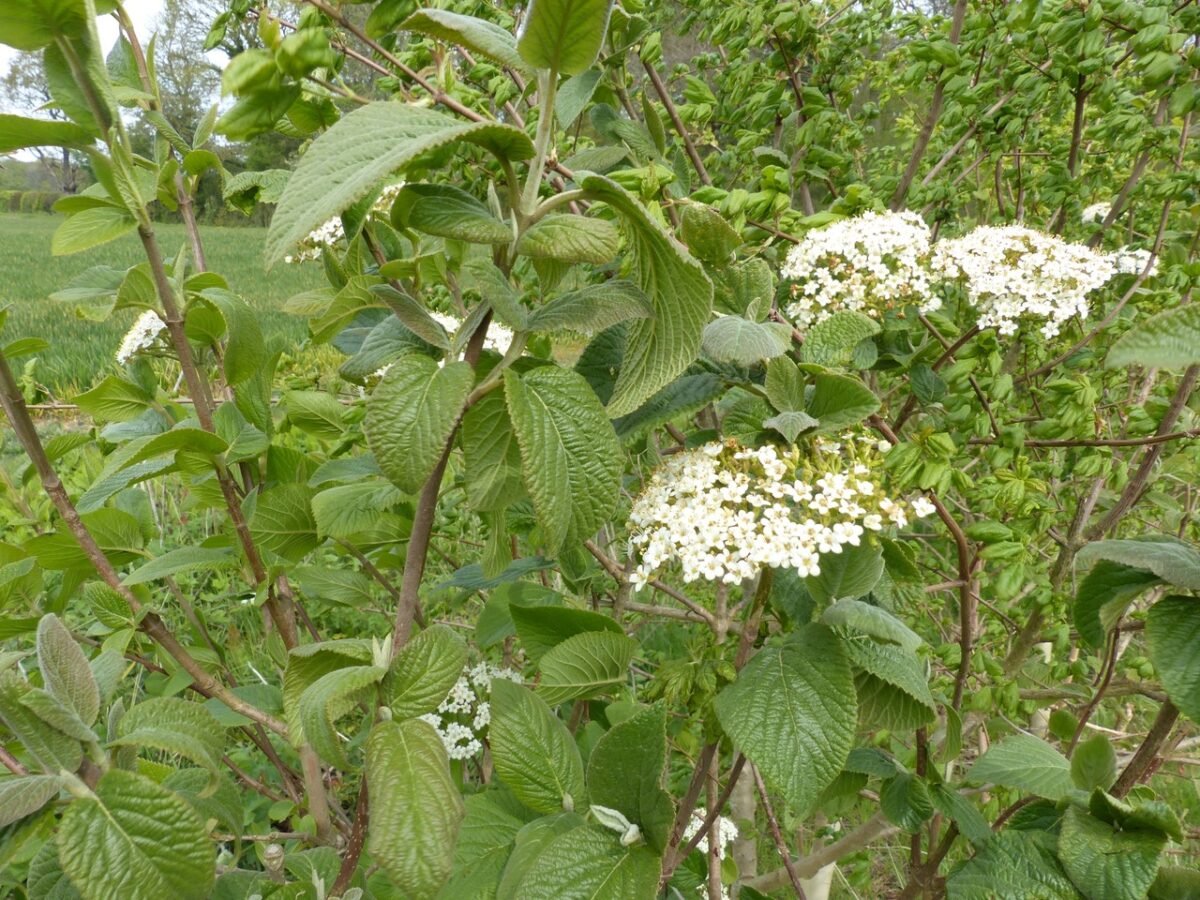
Our hedgerows rank high among the great glories of spring. You can follow them greening up day by day, from the first fresh buds in March through to the gorgeous extravagance of leaves and blossom in May. It’s an annual miracle of renewal and rebirth, driven by what the peasant-poet John Clare happily called, ‘the green life of change’. You can follow the succession of different hedgerow trees and bushes emerging in flower one by one – and revealing in the process just how many different species were hiding there unnoticed in the bare, skeletal hedgerows of winter. I just came across an old favourite while rambling along an ancient footpath, my attention caught by a lovely display of, creamy-white flowerheads shouldering vigorously through a mixed blackthorn and hawthorn hedge. A wayfaring tree. Their flowerheads look superficially similar to elderflower, but those come later and have quite different leaves (and, in autumn, berries). The wayfarer’s leaves are as attractive as the flowers – soft and wrinkly with fine veins, slightly coarse to the touch and downy-white on the undersides, hence its old country name ‘hoarwithy’. The present common name is a corruption of ‘wayfarer’s tree’, so called because it flourished alongside established footpaths and so helped reassure walkers that they were on the right track. It was the sixteenth-century botanist, John Gerard, who gave it this name, and since he also named ‘traveller’s joy’ (old man’s beard) perhaps he had a special sympathy with ramblers.
Wayfaring tree. Photo: Jeremy Mynott
It’s a revelation in fact how many other hedgerow species are there once you really start looking. In the same stretch I found field maple, dog rose, crab apple, dogwood, hazel and spindle, along with the dominant hawthorn and blackthorn, suggesting that this must be a very ancient hedgerow indeed. There’s a calculation called Hooper’s Law which is supposed to enable you to age a hedge by multiplying the number of species in a thirty-yard stretch by 110. But that would push the date of my hedge back to Domesday, which seems unlikely. I’m happy just to celebrate it, anyway. We’re lucky to have any ancient hedges at all. The British countryside went through a devastating period in the 1960s and 1970s, when farmers were encouraged to grub out hedges and drain ditches to enlarge fields to accommodate bigger and more ‘efficient’ agricultural machinery. We lost thousands of miles of hedgerows, and with them a huge slice of our wildlife, for which hedges act as shelters, corridors, larders and homes – mammals, birds, flowers and insects, the whole inter-connected chain of life. Many hedgerows have since been replanted, but you can’t make an old hedge any more than you can an old friend.
Jeremy Mynott May 2026
Nature Note: Murder on the Beach
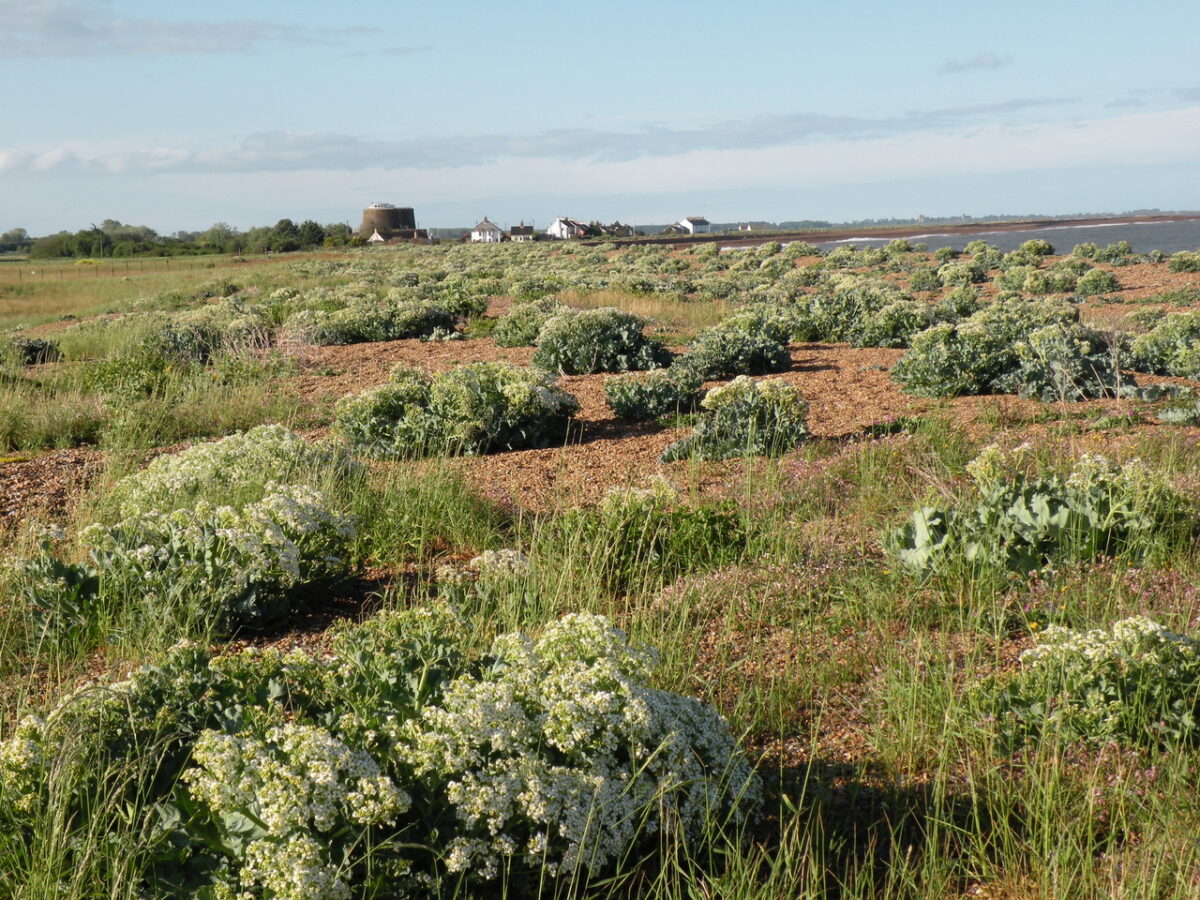
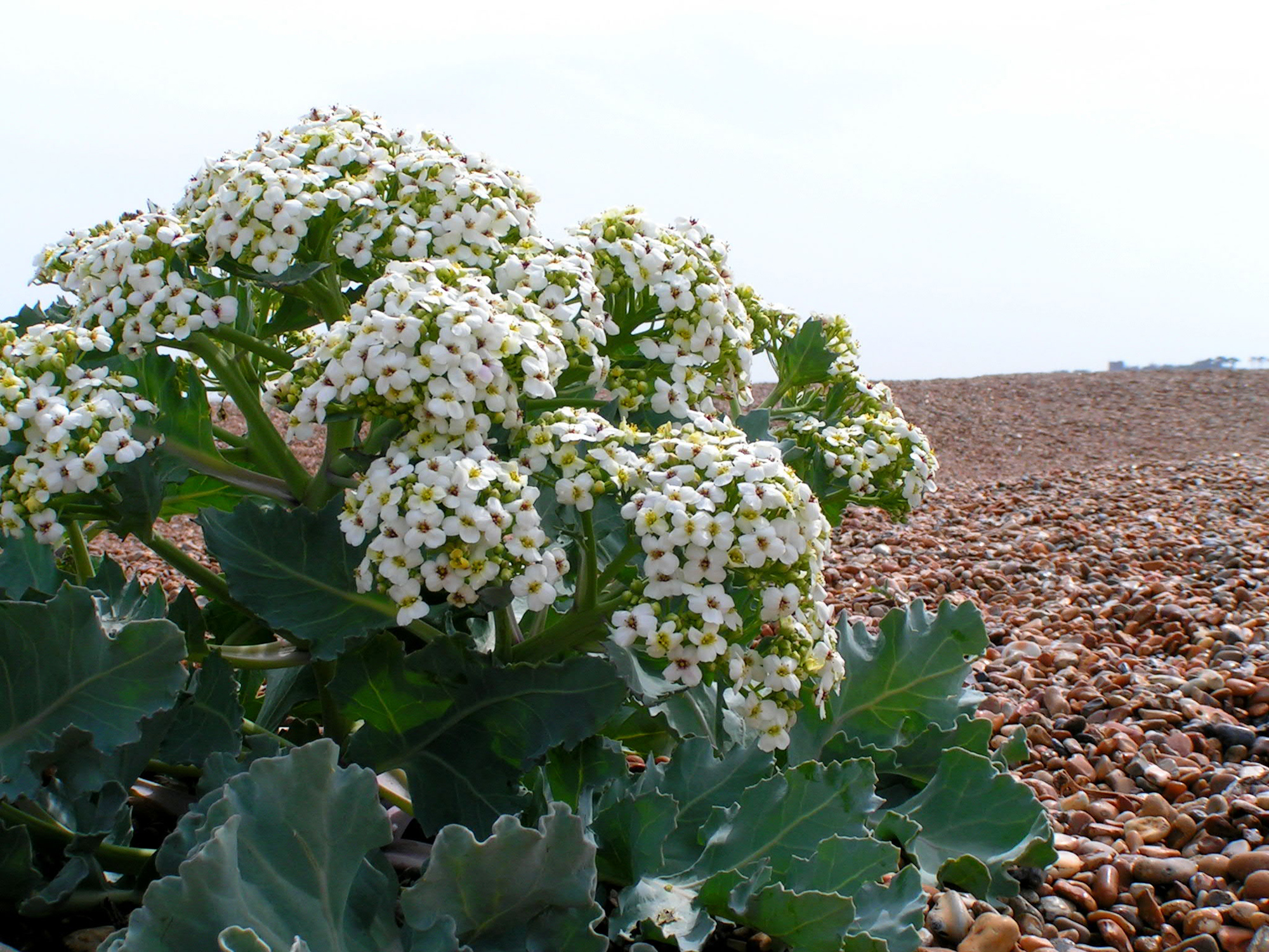
Shingle Street is famous for lurid stories about mysterious wartime fatalities on the beach, but we also had a better-documented one here last year. Our coastline is home to many rare and beautiful plants, none more striking than the Sea Kale that creates a wonderful swathe of foaming white blossoms on the shingle banks in early summer. Sea Kale is a kind of cabbage and when it emerges it looks for all the world as if the beach has suddenly sprouted gigantic cauliflowers everywhere. After Dungeness, this is one of the best places in Britain to witness this natural phenomenon. The Kale has to cope with an extreme environment, of course. It’s doused with salt spray, exposed to constant winds and parched by the sun; there’s no fresh water and almost no soil; while the shingle itself is unstable and constantly shifting. But the Sea Kale is specially adapted to cope with these testing conditions. It has very deep roots (up to two metres long) to suck up moisture and pale fleshy leaves to reduce water loss. The plant’s a survivor.
Sea Kale on the beach at Shingle Street. Photo: Jeremy Mynott.
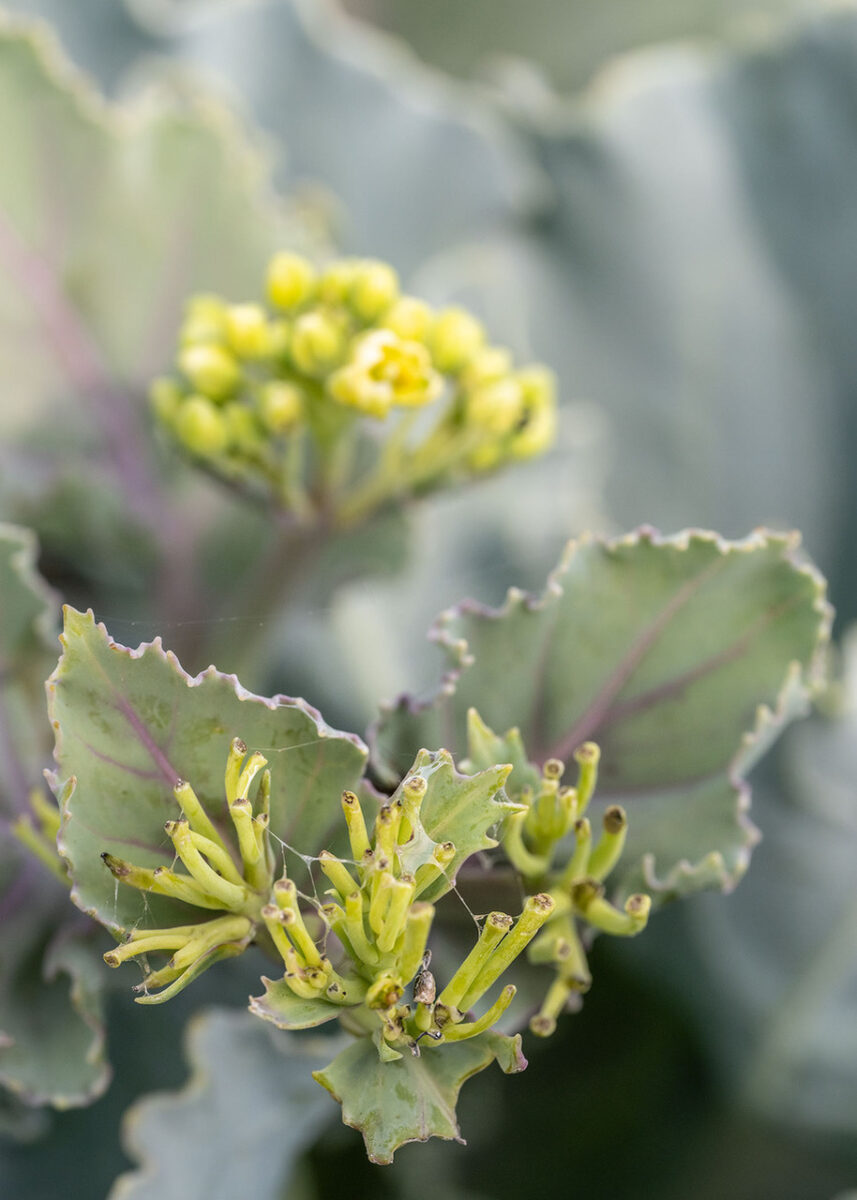
Something very strange happened last year, however. Summer came and went but the kale didn’t bloom in the stretch of shingle in front of the houses, where it has been such an annual delight to residents and visitors alike. What happened? Theories abounded. Had the plants just got too old and were declining naturally? Was it some disease? A caterpillar plague? Were they being nibbled by hares (which do visit the shingle)? Or perhaps by the flocks of wood pigeons we have everywhere now? Or even by human foragers – after all, although it’s strictly illegal now, people used to pick Sea Kale as a culinary delicacy when the plant was common back in Victorian times and it was even recommended as a tasty alternative to asparagus in Mrs Beeton’s celebrated Cookbook of 1861. But none of these theories explained why the Sea Kale should be affected like this just at Shingle Street and not along the beach from a few hundred yards south and all the way to East Lane, Bawdsey, where it was still flourishing,
Sea Kale damage. Photo: Liz Moon.
A vigilant insomniac here eventually came up with what seems to be the answer. She noticed that our resident muntjacs had started boldly browsing on the beach at night, maybe because the inland plants had been desiccated by last years’s long spring drought; and her observation was later confirmed by some close-up photos that showed the Sea Kale stalks nipped off cleanly at the top. What will happen this year? And what’s the solution? Is it a choice between cabbage and venison?
Jeremy Mynott April 2026
Nature Note: Blackthorn Spring
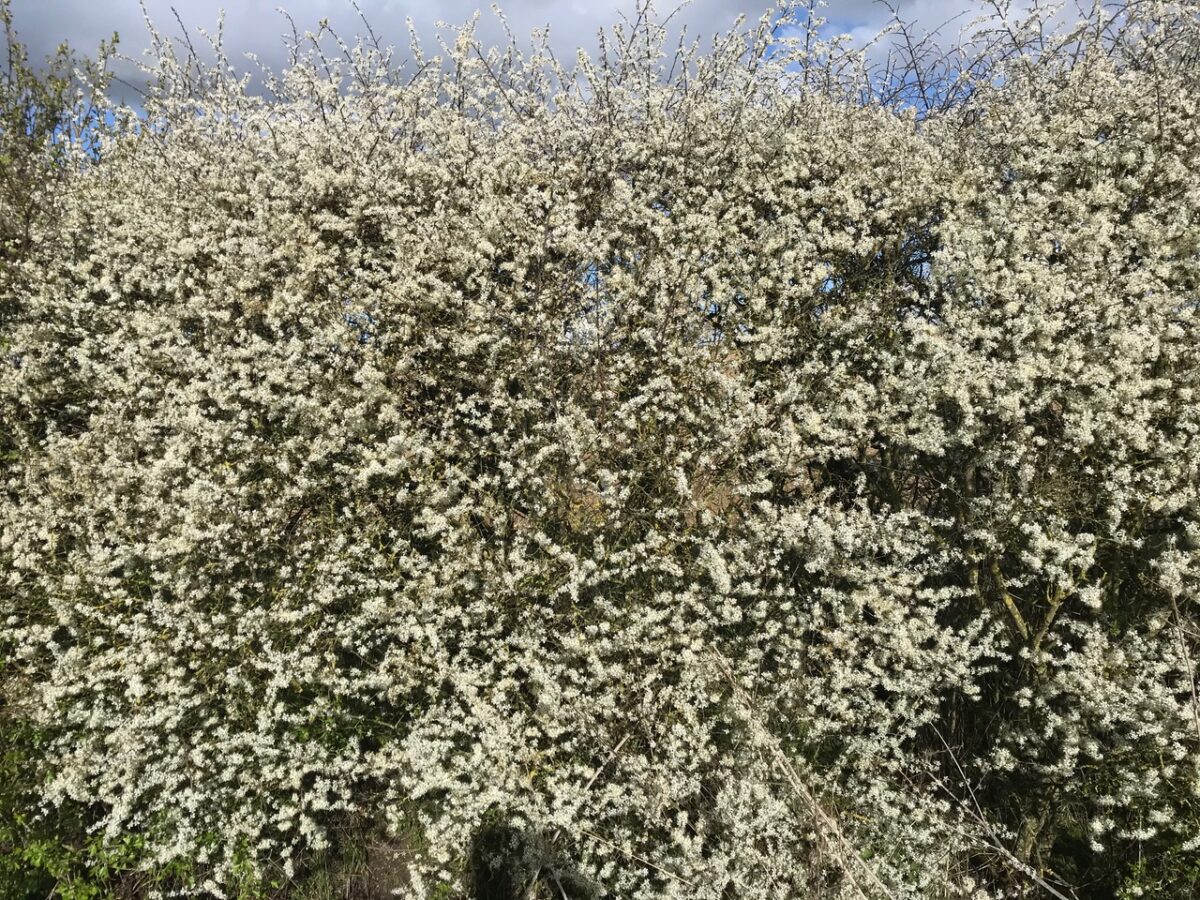
Climate change is changing our language too. Do you remember the old country saying about a ‘blackthorn winter’? It was a reference to that period in March and April when the blackthorn blooms in our hedges, well before the whitethorn (hawthorn) and other hedgerow species ever come into flower. This is a striking phenomenon in various ways. Most obviously, because in early spring the blackthorn blossom forms a brilliant white boundary along roadsides and across the fields, like a dazzling band of fresh snow. It’s one of the most cheering and beautiful early manifestations of what is for most people the most uplifting season of the whole year, with its promise of warmth, growth and light after the long winter’s wait while nature was battened down. One reason a blackthorn hedge looks so dramatic in spring is that unlike most other flowering bushes the blackthorn produces its flowers before its leaves, so the blossom contrasts strongly with its blackish bark, which looks as if it has been frosted like a Christmas decoration on every twig.
A Blackthorn hedge in bloom. Photo: Jeremy Mynott.
But the phrase ‘blackthorn winter’ referred also to the fact that this promise might be punctuated or delayed by sudden bitter spells and chilly blasts, as winter administered a final, sharp reminder of its powers. The nineteenth-century Scottish meteorologist, Alexander Buchan, even claimed to have identified a systematic pattern to these bitter spells, which became known as ‘Buchan’s cold snaps’. In fact, the occasional conjunction of the flowering blackthorn with short wintry interludes was an easy prediction to make, but Buchan made the mistake of being too precise about it. April 11-14 and 9-14 May were his spring dates for a seriously ‘cold snap’. Well, check it out when the time comes, but I’d be surprised if it happens. Buchan may have won credibility by sometimes being right, like a canny fairground fortune-teller who tells you that something interesting is about to happen to you, but it was actually pretty random. In any case, Buchan knew nothing then of climate change. We’ve scarcely had a winter in East Anglia this year, certainly not an old-fashioned freeze-up, just a handful of frosty nights and only one day I can remember with a single snow-flake (on my birthday, as it happened).
Perhaps the invocation of the ‘blackthorn winter’ will survive as a metaphor, annually celebrating the blackthorn’s dense drifts of white blossom, even as we re-define winter itself to suit the changing meteorological facts. But the phenomenon of snowy blossom appearing in warm March weather may presage the next impending crisis the world is facing – as well as creating a new proverbial reference to a ‘blackthorn spring’.
Jeremy Mynott 3 March 2026
Nature Note: Buckthorn Beauties
Not long to go now. March is the beginning of spring in our meteorological calendar. It was the first month of the year for the ancient Romans, who called it ‘Martius’ after Mars, their God of War, because it was the season when the weather became good enough for them to start fighting again. We have inherited the name and for us too it marks a beginning, but happily of a more creative kind. It’s the start of that unstoppable rush of new life, light and growth as the green wave of spring moves northwards through Europe and reaches our shores. We all have our own markers of this annual rebirth: the daffodils flowering, the hedges leafing, a chiffchaff singing in the copse on its return from Africa, or a wheatear in fresh plumage foraging on the beach. But for me one of the most stirring is that first sight of a butterfly on the wing, probably a lovely brimstone floating round a sheltered garden on a sunny day in early March.
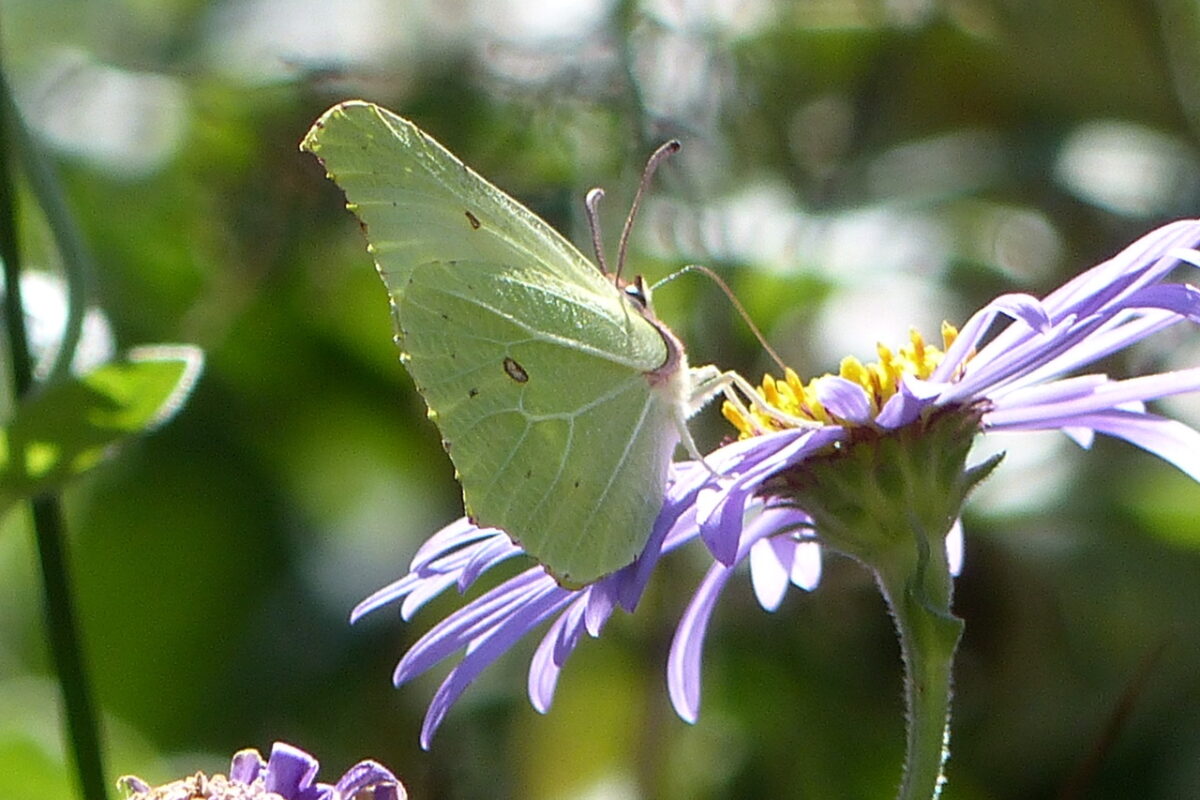
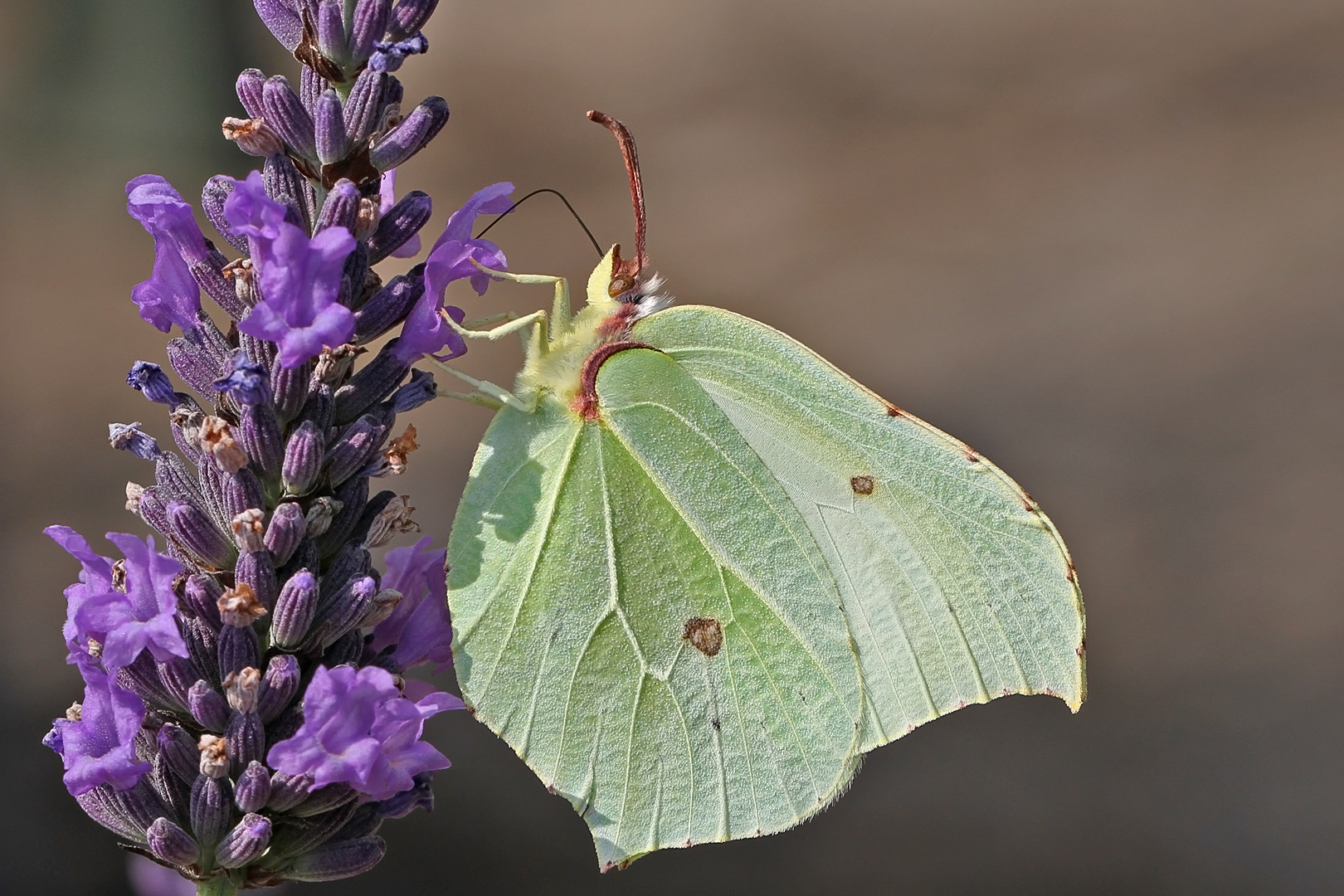
A Brimstone butterfly. Photo: Jenny Desouter.
They are so-named after the colour of brimstone, the old name for sulphur (remember ‘fire and brimstone’ in the Bible?). The male brimstone is a gorgeous buttery yellow, the female paler (and slightly larger), but both unmistakeable on the wing with large rounded wings hooked at the tip and a strong buoyant flight. When they settle they always do so with wings closed and their wonderful camouflage is then displayed, their greenish veined underwings looking for all the world like leaves. It has been suggested that the male’s striking colouration is the origin of the name butterfly itself, a ‘butter-coloured fly’ – an attractive thought, but unlikely alas. Brimstones appear this early in the year, not because they have just emerged from a chrysalis but because they are one of the few British butterflies that actually overwinter as adults. At the first hint of any warmth in the sun they come out from their winter hiding-places, where they have been concealed in thick ivy or other evergreens like holly, and search out some reviving nectar. They’ll often suck it from early flowering daffodils and primroses, but their most favoured sources are purplish flowers like knapweed, teasel or thistle, and in the latter two a brimstone can reach down into the plant with its long proboscis further than most other butterflies.
The favourite food plant of their caterpillars, however, is buckthorn (common or alder), which is not very widely distributed so they need some nearby to lay their eggs on. Brimstones are also one of our most long-lived butterflies, emerging one summer and lasting right through to the next. Worth planting some buckthorn for?
Jeremy Mynott February 2026
Nature Note: Last Leaves
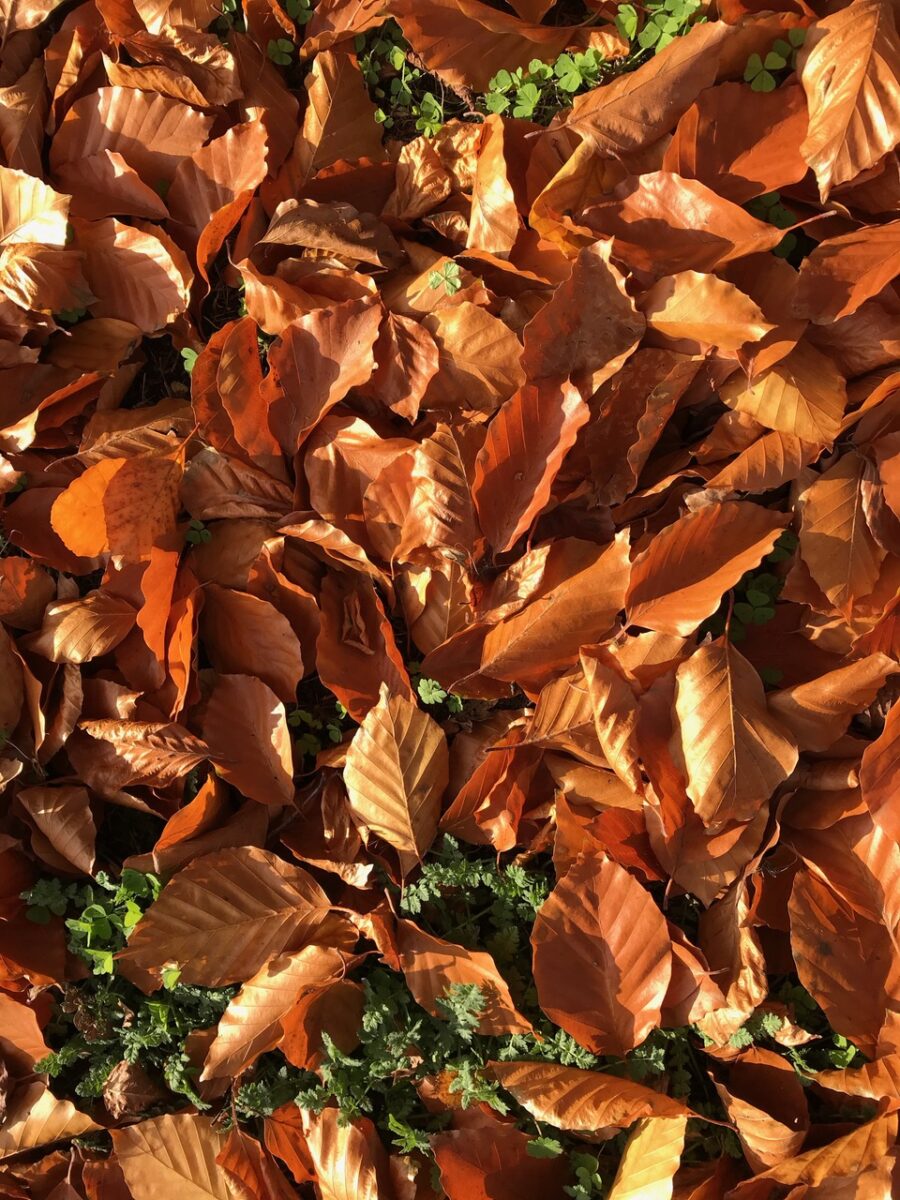
I strode out from the house on one of my regular walks the other morning and after I’d gone a couple of hundred yards I suddenly realised I was naked. Well, not completely of course, but when I went to raise my binoculars to look at a distant bird I discovered with a shock that I’d left them back at home. They’ve been so constantly around my neck on walks since childhood that at first I felt I’d lost an additional organ of sight. I still had my five original senses, though, and I started exploring my immediate surroundings more closely with them instead. There were two trees still in leaf, I noticed, a beech and an oak. I picked some of their leaves to examine them more intimately. They had a crisp, dry papery feel and crackled pleasantly to the touch. I sniffed them – the beech leaves had a soft, earthy odour but the oak ones hinted at some deeper fragrance I couldn’t quite place. I glanced around to see if I was being watched and warily nibbled a few. I could now taste a tang of sharpness in the oak leaves and spat those out pretty sharply. Don’t try this at home – I think it was probably the tannin and is meant to deter deer and other foragers. Looked at closely, the beech leaves were particularly beautiful, a rich chestnut colour with their internal veins prominently exposed as they branched out from the mid-rib like little tree skeletons. A perfect natural image of the vascular architecture.
Autumn beach leaves. Photo: Jeremy Mynott.
The leaves were still strongly intact, however, and firmly attached to the parent trees. Why, I wondered, do oaks and beeches hold on to their leaves so long, often right up to next spring, when other deciduous trees shed them – in one of the defining manifestations of autumn (the North American ‘fall’)? When I got back home and was restored to my books (and binoculars) I tried to investigate this and learned a new word describing the phenomenon, ‘marcescence’ (evidently new to spellcheckers, too). The scientists have this technical term for it but it turns out they don’t really know why it occurs. Some suggested explanations are: that it helps protect the growing buds from foragers like deer (and me); that it ensures the leaves will eventually fall close to the tree’s roots and so recycle its nutrients; that it deters predatory insects; or all of the above. But none of these answers seem to explain why as a strategy marcescence is restricted just to oaks, beeches and a very few other trees like hornbeam.
New explorations for a new year.
Jeremy Mynott January 2026
Nature Note: Charismatic Guests
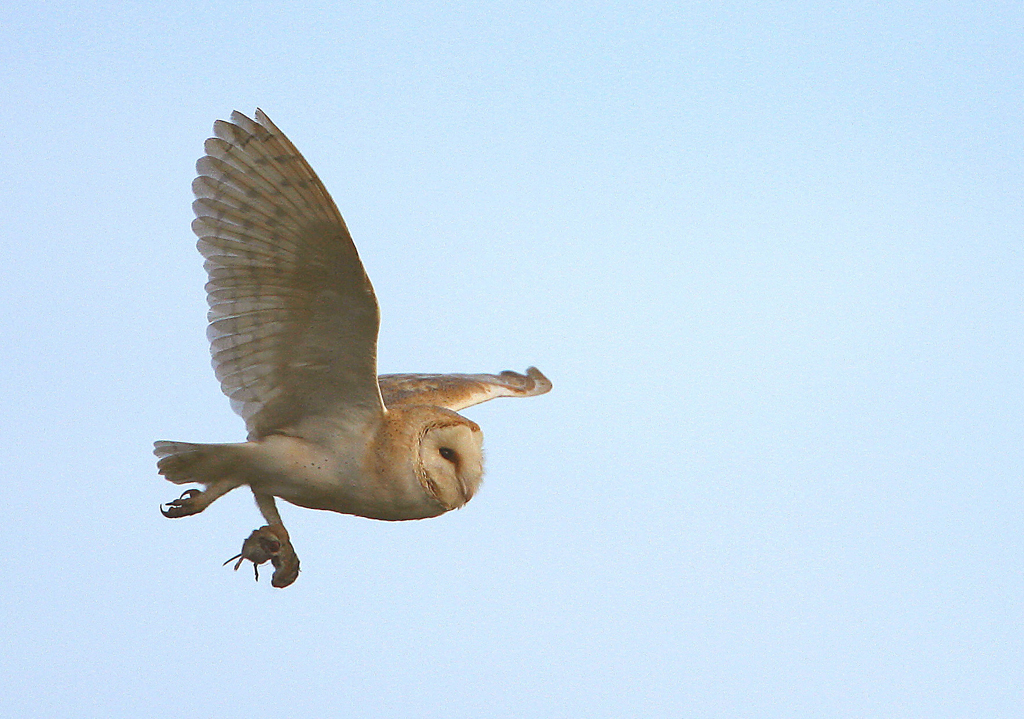
This is the time of year, as the days darken into winter, when some charismatic visitors arrive to dispel something of the dank and gloom. They come from the forests and fields of Scandinavia, arriving usually by night – long-winged, silent travellers seeking a milder climate and more readily available food supplies. Short-eared owls. Every year they grace our marshes and grasslands, patrolling them for the small rodents which are their staple fare, especially field voles. Unlike most owls these short-ears hunt by day. They rely on a combination of sight and hearing, both exceptionally acute by human standards, to locate their tiny prey from above and seize it in a sudden plunging descent. It makes for a wonderful spectacle for bystanders. The owls quarter the field, flying low over the ground, now gliding, now slip-sliding or hovering for a better look; then the final, and for their victims terminal, deep dive. You can often watch them close-up from the roadside and marvel at their variegated plumage of soft browns, buff, tawny and in some lights ochre-tinted colours, contrasting with dramatic orange eyes set in black mascara-lined sockets. Their numbers vary by the year, depending on the fluctuating cycle of rodent populations. It is said that they can consume some 2,000 voles in their four-month winter sojourn among us – did you realise we had so many? Some short-ears linger into the spring and occasionally even stay to breed on local marshes and seawalls. Further north in Britain they breed regularly on the moors and uplands but here they are thrilling seasonal visitors.
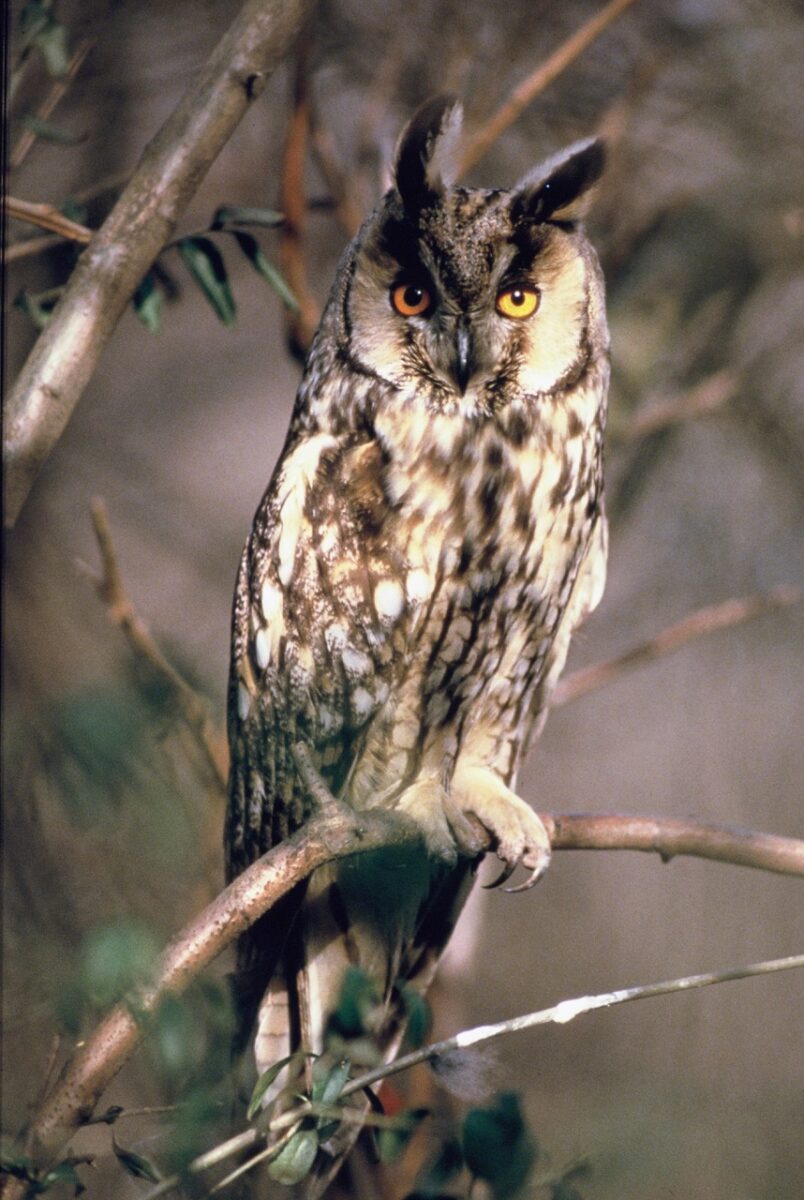
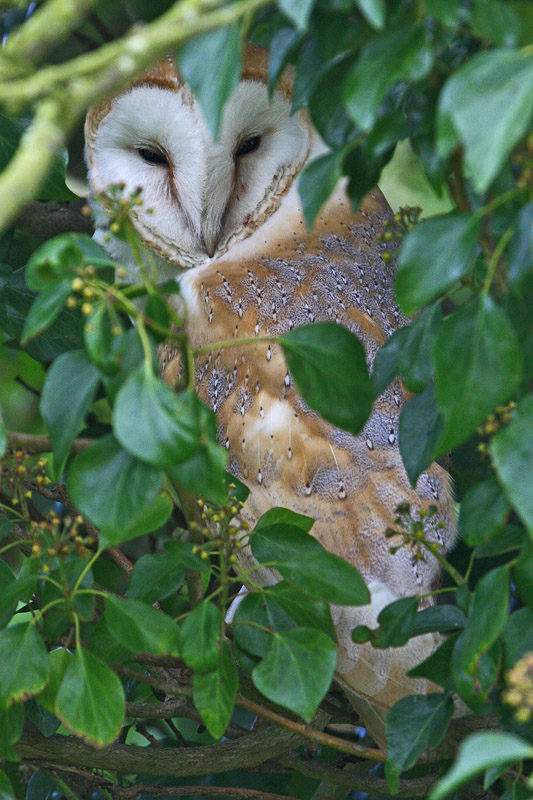
Long-eared owl
Their name sounds faintly ridiculous and indeed the small protrusions on their heads are not ears at all but just little feather tufts. Their real ears are lower down on the head, invisible through the thick plumage and positioned asymmetrically, one higher than the other, to give them a better positional fix on the faintest rustlings below. There is also a better-endowed owl called the long-eared owl (LEO, to birdwatchers), with very prominent long ear-tufts. These are resident in Britain and quite widely distributed but are purely nocturnal, very secretive and rarely seen. Their numbers are supplemented by migrants from Scandinavia in winter, too, and LEOs are occasionally spotted in their temporary winter roosts. A neighbour of mine had a magical epiphany the other day when she drew back the bedroom curtains in the morning and saw one sitting on a horizonal branch just a few feet away outside, staring directly in at her. Wisely, she didn’t broadcast this great discovery so the legion of owl-obsessed bird-photographers never troubled it and it left the next night like a fading dream.
Jeremy Mynott November 2025
Nature Note: Acorns
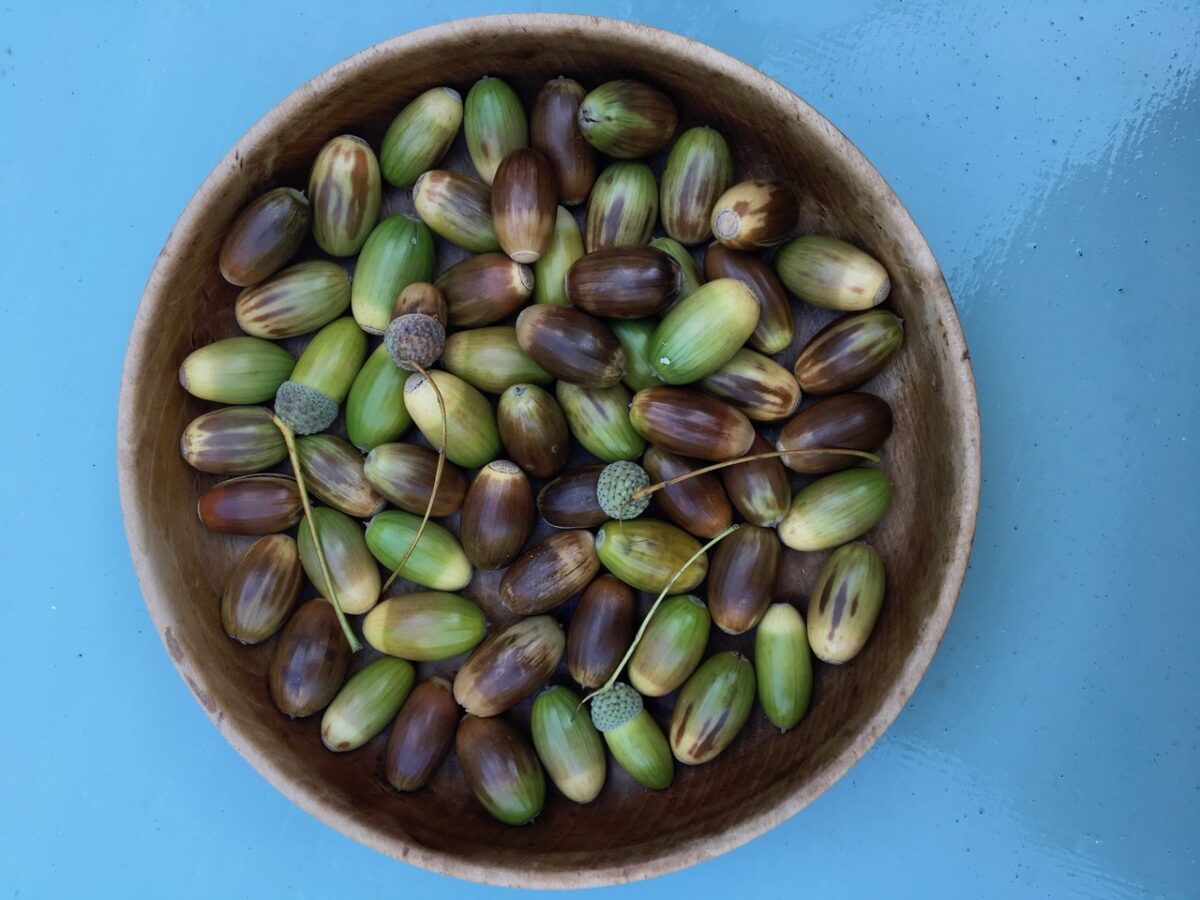
It’s been a bumper year for acorns. The ground under oak trees is strewn thick with these lovely oval nuts, some of them still enclosed in their little knobbly cups. It’s been what they call a ‘mast year’, when the weather conditions in spring and summer offered just the right combination of sun, warmth and rain to pollinate the trees and fatten their fruits. And acorns are the fruits of the oak. The word is derived from the Old English ac (oak) and corn (their fruit). I asked a fruit farmer recently what a fruit actually is and he came up with this interesting answer, ‘it’s a seed dispersal mechanism’. Oaks don’t produce acorns in this profusion every year, but in a mast year they create far more of them than any of their natural consumers can possibly eat on the spot – the technical name for this strategy is ‘predator satiation’ – and that encourages long-term planners like squirrels and jays to carry the acorns away and bury them in scattered locations from which they can later retrieve them for tasty winter snacks. Inevitably they will forget where they hid a few of them, and so will have effectively planted and dispersed lots of new oak seedlings. Clever Nature.
Acorns are very rich in tannins and are seriously harmful in their raw state to some other animals, including dogs, horses and humans. If they are boiled or roasted, however, you can leach the tannins out and then they are said to make nutritious flour or even decaffeinated coffee. In some human cultures, like those of certain native North American tribes, acorns were a staple item of diet when properly prepared in this way, so maybe we should experiment more (cautiously!). Pigs don’t need that detoxification process, however, and there was an ancient forest right called pannage, whereby you could let your pigs out into the woods to gorge themselves on acorns for an authorised period every autumn. In fact, they still observe that practice in the New Forest in Hampshire and the permitted pannage season there this year is from 15 September to 28 November, in case you’re interested.
A bowl of acorns. Photo: Jeremy Mynott.
Oak trees themselves are one of the glories of our woodlands. They support an incredible range of wildlife: some 2,300 other species depend on them in part for their food, shelter and living quarters. These include birds (woodpeckers), mammals (badgers, deer, wood mice), many lovely moths and butterflies (crimson underwings and purple hairstreaks), bees, hoverflies, beetles, fungi, lichen and mosses; and of these over 250 depend wholly on oaks. No wonder the oak and the acorn are such powerful symbols of growth, abundance, fertility and life.