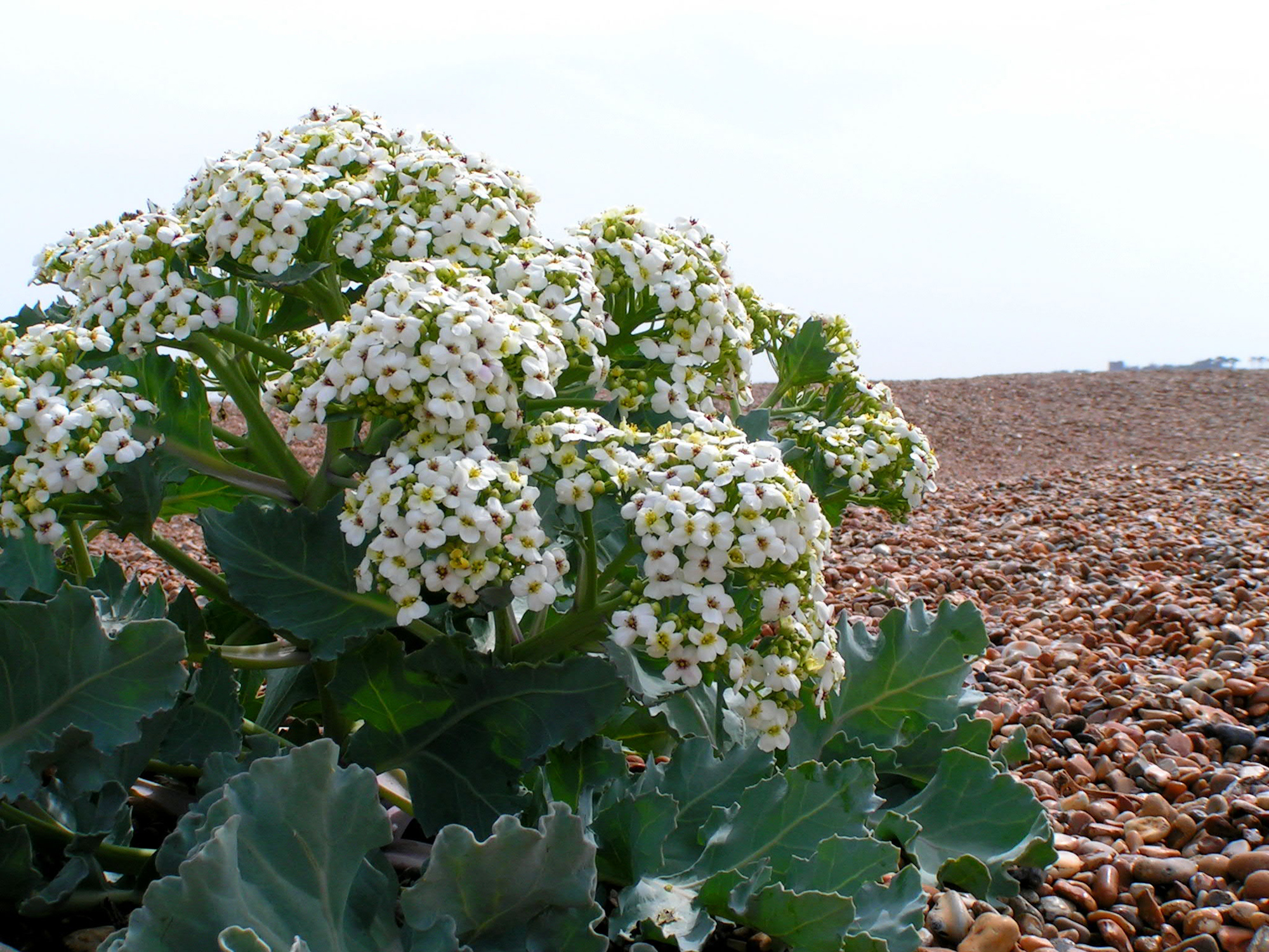
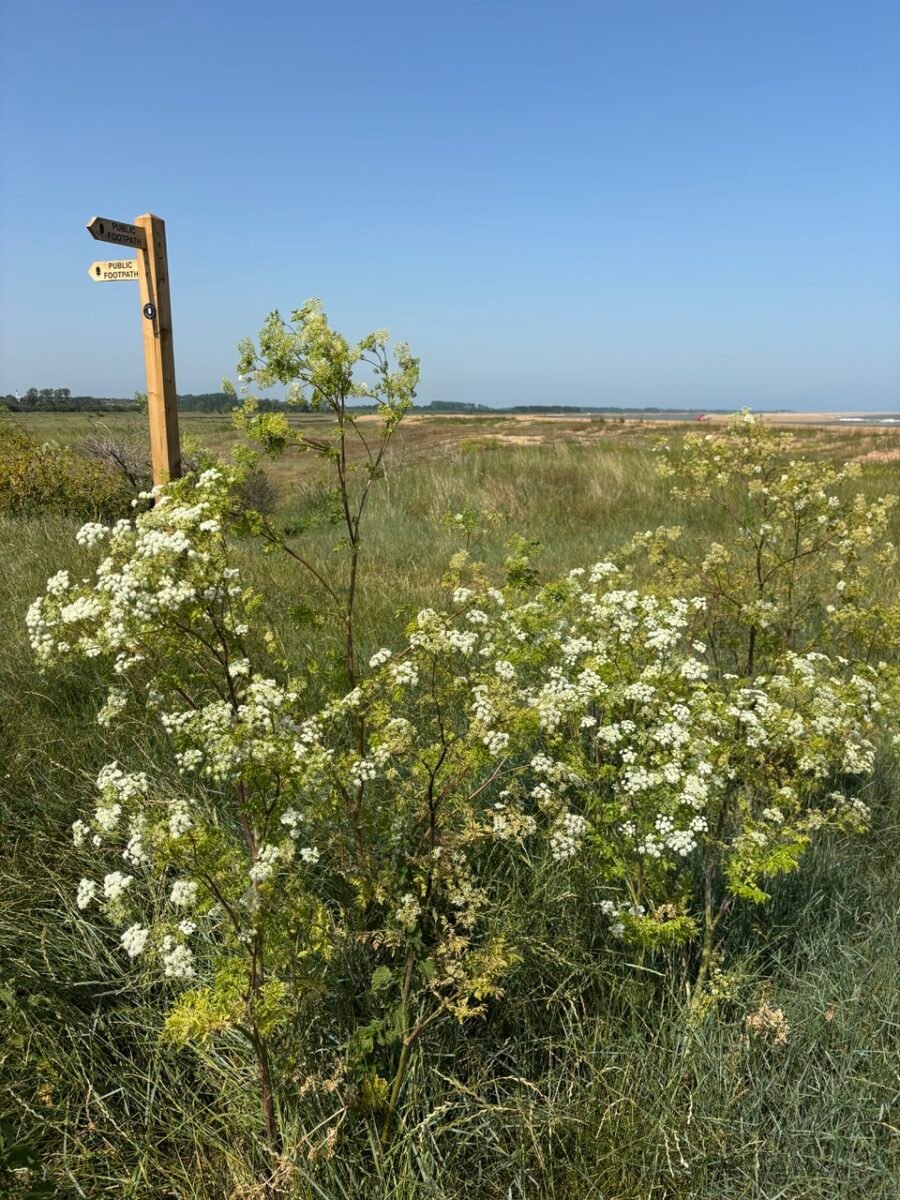
If you walk the sea-walls regularly you’ll be familiar with the cow parsley and hogweed that flourish either side of the path in an attractive white avenue. They are among the commoner members of the large family of flowering plants called Umbellifers, that is, plants with umbels, those clusters of whitish flowers supported by little stalks spread out like umbrella ribs. Other members of the family include economically important plants like chervil, wild carrot, fennel, parsnip, angelica, parsley and dill, so you may find some of them in your favourite salads and summer dishes.
Beware imposters, though, especially if you are a wild flower forager. There is a deadly look-alike among them – hemlock. Hemlock leaves are bright green, rather fernlike, and with jagged edges; but the easiest way to distinguish them is by the stems, which are spotted with purplish dots and blotches. Every part of this plant is potentially dangerous – leaves, seeds, stems and roots – and dangerous to livestock and dogs as well as to humans if ingested. Animals know well enough to avoid it, however, deterred by its pungent mousy smell.
Hemlock is a native and widespread plant in Europe and its properties have been well-known for at least 2000 years. It was the poison of choice for public executions in ancient Greece and its most famous victim was the philosopher Socrates, who was condemned to death by the state for teaching the young to ask difficult questions of their politicians. His pupil Plato gives us a very moving eye-witness account of Socrates’ final hours as he is administered his dose of hemlock, combined with opium to dull the pain. The philosopher goes on discoursing cheerfully with his friends as the poison works its way up his body until he finally loses consciousness. Later herbalists experimented with ways of using very small doses of hemlock to treat complaints like gout, but don’t try this at home!
You can read an account of the terrible bodily torments Socrates might actually have suffered in a splendid new book by the botanist Peter Marren, The Devil’s Garden, in which he enthusiastically describes all the world’s most deadly plants with his deadpan graveyard humour. Maybe don’t show it to your gardener, though.
Hemlock is commoner here than you might think. There is a patch on the sea wall by the northern carpark at Shingle Street. And it is rampant along the verges of the A12 and other main roads, fuelled by nitrogen-laden car fumes. The Victorians used flowers as symbols to send covert messages, usually romantic ones, but if you were sent a sprig of hemlock the message was ‘You’ll be the death of me’.
Jeremy Mynott
July 2026